
Swimming pool contractors in Dubai and how the best of them run your site
A pool is built in your garden, a few metres from your living room, over a period of eight to sixteen weeks. Most buyers compare swimming pool construction companies in Dubai on price and on photos of finished pools. Very few ask who will be on site every day, how the site will be run, and what happens to the house, garden and neighbours while the work goes on.
That gap causes most of the stress in a Dubai pool project. The drawings are usually fine. The problems start on site: a concrete truck that can’t reach the back garden, a pour started at noon in July, a boundary wall cracked by an excavator, and an irrigation line cut on day two and never reported. This guide is about the site. It covers the people you should expect to meet, the checks you can make yourself on a site visit, the rules that shape a building day in Dubai, and the questions that separate the best pool contractors in Dubai from the rest.
It is written by Green Creation, a Dubai company that started in landscaping and later added pool building and has now completed 8,940 projects for more than 5,500 clients. We have tried to write it so it is useful even if you end up hiring someone else.
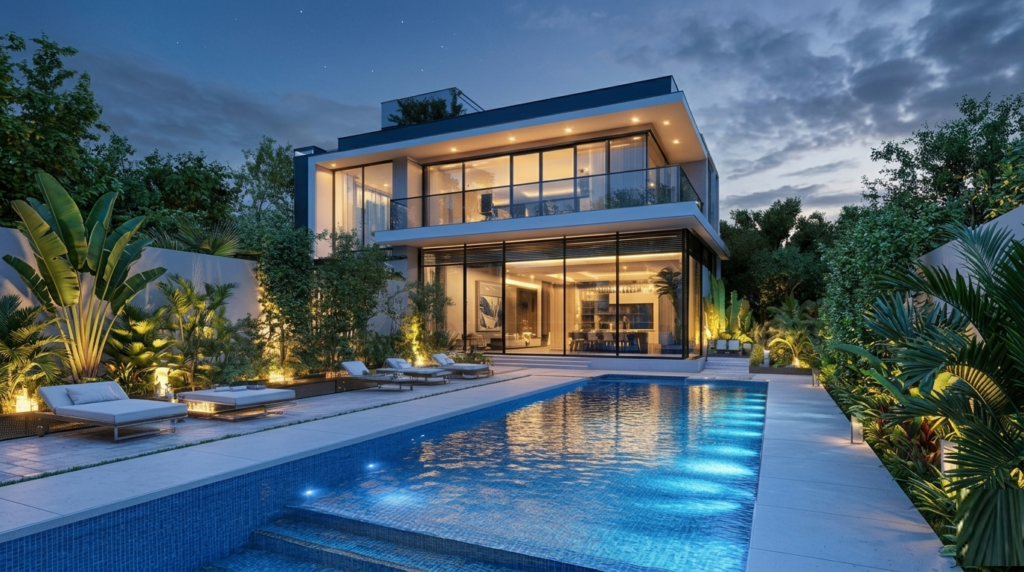
A Green Creation site: the same crew from set-out to handover.
⚡ Short answer
The best swimming pool contractors in Dubai show you three things before they quote: a named site team with a person in charge, a written plan for access, spoil, water and power on your plot, and a list of the inspections they will record at each stage. A firm that can only show you finished photos and a price has not yet thought about your site. Green Creation plans the pool and the garden as one job, agrees every design detail and component cost in writing, and keeps the same company responsible after handover through its maintenance teams.
📋 What’s in this guide
- Four searches, one decision
- Who should be on your plot
- The site survey before any quote
- Permits and rules that shape a building day
- What happens on site, stage by stage
- Heat, groundwater and dust
- Protecting your home and garden
- Neighbours and the community
- Checks you can make on a site visit
- Site diary, reports and variations
- What goes wrong on a badly run site
- Questions to ask pool contractors in Dubai
- Why Green Creation
- What site work adds to the cost
- After the site closes
- Further reading
- Frequently asked questions
Four searches, one decision
People looking for a pool builder in Dubai type slightly different things into Google. The words change, but the decision behind them is the same. It still helps to know what each phrase usually means in this market, because the firms that show up for each one are not always the same kind of business.
Swimming pool construction companies in Dubai
This phrase tends to bring up the larger firms: companies with their own excavation plant, steel fixers, concrete crews and plant-room fitters on the payroll. A construction company of this kind carries the structural risk itself. It pours the shell, it tests the pipes, it waterproofs, and it answers for the result. If you are building a new pool in a villa garden, on a roof, or for a hotel or a residential community, this is the category you want to be comparing. Our overview of what sets the best construction companies apart goes deeper into company size and capability.
Swimming pool construction in Dubai
This inquiry is usually a search for the process, not the firm. People want to know how long it takes, what it costs and what happens in which order. The honest answer depends on the plot. A 6 x 3 metre villa pool with decent side access and dry ground can have its shell poured in the third or fourth week. The same pool on a reclaimed plot on the Palm, with water sitting a metre below the lawn and a 900 mm side passage, is a different job. The site programme later in this guide shows where the time is spent. For a first read on the build stages, see our step-by-step guide for villa owners.
Swimming pool contractors in Dubai
A contractor is the party that signs the contract with you and takes responsibility for the whole job. Some contractors do every trade in-house. Others sell the job, then hire out the dig, the steel, the concrete and the tiling to separate subcontractors and act only as a coordinator. Both models exist in Dubai and both can work, but they feel completely unique on site. With the first, the same supervisor is on your plot for three months. With the second, you may meet five different gangs, and nobody on the plot works for the company whose name is on the contract. Our longer piece on what to know before signing any contract covers the contract side.
Pool contractors in Dubai
The shorter phrase is often typed by people who already have a pool. They want a repair, a renovation, a new pump, a leak found or a weekly service. A reliable pool contractor in Dubai handles that work too, and it is a useful test of a builder. A firm that also maintains pools sees, every week, what fails after the builders leave. That feeds straight back into how it builds. Green Creation’s pool service teams and repair department work from the same office as the construction team.
Who should be on your plot?
A villa pool is not built by one person. It passes through at least eight trades. The table below lists the people you should expect to see, what each one does, and when they arrive. Ask any contractor you are comparing to fill in the right-hand column with names. If they can’t, ask why.
| Role | What they do on your plot | When they are there | What to ask |
|---|---|---|---|
| Project manager | Owns the programme, the budget, the permits and your questions. Your single contact. | Whole job, visits at least weekly | Is this person employed by the contractor, and how many other sites do they run at once? |
| Site engineer | Checks levels, steel, pipework and concrete against the drawings. Signs off on each stage before the next one covers it. | At every hold point | What is their qualification, and will they sign an inspection record? |
| Site foreman | Runs the crew day to day, opens and closes the site, and keeps it tidy and safe. | Every working day | Will the same foreman stay on my job from dig to handover? |
| Excavation crew | Sets out the pool, digs, trims the sides, loads spoil, and runs dewatering pumps if needed. | Week 1 to 2 | What machine will fit through my access, and where will the spoil go? |
| Steel fixers | Cut, bend and tie the reinforcement cage, and fit spacers and cover blocks. | Week 2 to 3 | What bar size and spacing are on the drawing, and who checks it before the pour? |
| Hydraulic fitter | Lays suction and return lines, main drains, skimmers, and inlets and pressure-tests them. | Weeks 2 to 3, again at the plant room stage | What pressure will the pipes be tested at, and for how long? |
| Concrete crew | Places and compacts the shell concrete or shotcrete, takes cube samples, and starts curing. | Pour day, then daily curing visits | What time will the pour start, and how will the shell be kept wet afterwards? |
| Electrician | Bonding of metal parts, pool lighting, plant-room supply, and DEWA load paperwork. | Before the pour, then at the plant room stage | Will there be a continuity test of the bonding before it is buried? |
| Waterproofing applicator | Prepares the cured shell and applies the membrane or cementitious system. | After curing | Which product will be used, how many coats will be applied, and will there be a flood test? |
| Tiler and stone mason | Lines the pool, sets coping and deck, grouts, and cuts around fittings. | Weeks 6 to 10 | Which adhesive and grout are specified for submerged use? |
| Landscaper | Reinstates the garden, planting, irrigation and lighting around the new pool. | Final weeks | Is the garden in the same contract, or am I hiring someone else later? |
| Commissioning technician | Starts the plant, balances flow, sets dosing and controls, and trains you. | Fill and handover | Will I get a written record of flow rates and water readings on day one? |
Swipe the table sideways to see every column.
A named foreman and engineer, not a rotating cast, on a Green Creation site.
Two roles on that list matter more than the rest. The foreman decides what your site looks like every day. The site engineer decides whether problems get caught before they are buried in concrete. A contractor who sends a foreman but no engineer is asking you to trust that nobody made a mistake with the steel.
The landscaper row is where Green Creation differs from most firms. We began as a landscaping company. Our garden teams are on the same payroll as our pool teams, so the person who reinstates your lawn and irrigation is part of the same programme from day one, not a stranger booked after the pool is full. You can read more about how we approach pool landscaping in Dubai.
The site survey before any quote
A serious quote starts with someone walking your plot with a tape measure. Some firms in Dubai quote from a WhatsApp photo and a rough size. That quote will change once they arrive, and it will not change in your favour. Here is what a proper survey covers and why each item matters.
Access for machines and trucks
A standard skid excavator needs a clear opening of about 2 metres wide and under 2 metres high to reach a back garden. Many Dubai villas and townhouses have a side passage well under that, often with an AC unit, a gas cylinder cage or a boundary wall return in the way. Narrow access doesn’t stop a pool. It changes the method. Mini excavators, motorised barrows, hand digging or a crane lift over the house all work, but they add days and cost. A contractor who has measured your access will tell you which method they plan to use before you sign.
Where the spoil goes
An 8 x 4 metre pool at an average 1.5 metre depth needs a hole of roughly 8.6 x 4.6 x 1.8 metres once you allow for the shell and the base. That is about 70 cubic metres of ground, which swells to something near 90 cubic metres once it is dug and loose. Several truckloads. It has to sit somewhere before it leaves, and in a gated community the trucks have to be booked through the gate. Ask where the pile will be, how long it will be there, and whether it will be covered against wind.
Services under the ground
DEWA cables, water lines, drainage, irrigation mains and telecom ducts all cross villa gardens. Most are on the as-built drawings you received with the house; some are not. A good survey marks them before the dig and plans the pool around them. Our guide to preparing your property for a pool installation lists what to have ready.
Setbacks, easements and distance to the house
Your affection plan and your community’s design guidelines set how close a pool can come to the boundary and whether it can cross a service easement. Separately, digging close to the villa’s foundations needs a structural check, because the excavation can undermine the soil under a footing. The survey should end with the pool position marked against all three.
Ground and water
On inland plots in Arabian Ranches, Dubai Hills or JVC, the ground is usually dry sand and the water table is deep. On reclaimed land and near the coast, water can sit close to the surface, and the soil can carry salts that attack concrete. A contractor who has built in your community will know this already. For new areas, a soil investigation is cheap compared with fixing a shell that lifted when it was drained. Our note on pool construction materials for Dubai’s climate explains why sulphate-resisting concrete is specified on some plots.
Water, power and a place for the crew
The site needs a water point with decent pressure for mixing and curing, a power supply for tools and pumps, and a shaded spot for the crew to rest. Agree in writing whose water and electricity will be used and whether a temporary meter or generator is needed. It sounds small. It is a common argument in week three.
Permits and rules that shape a building day
Dubai has specific rules that decide when work can happen and how loud it can be. A contractor who knows them plans your programme around them instead of finding out the hard way.
| Rule | What it means for your build |
|---|---|
| General construction hours | Standard working hours in Dubai run from 7am to 8pm. Work outside that window, including an overnight concrete pour, needs a separate night-work permit. |
| Residential noise limits | Noise in residential communities is expected to stay within 45 to 60 decibels during permitted hours. A villa community with close-set houses is a place to plan noisy work, such as breaking out old paving, for the middle of the day rather than early morning. |
| Summer midday break | From 15 June to 15 September, outdoor manual work stops from 12pm to 3pm across the UAE. Fines run up to AED 5,000 per worker found working, capped at AED 50,000 for repeat violations. This is a labour-safety rule, not a construction-hours rule, and it applies whether or not your pool has a permit. |
| Dewatering discharge | If groundwater has to be pumped out during excavation, it cannot simply be run into the street. Authorities can require layout plans, discharge-flow estimates and, in some cases, filtration before the water reaches drainage. Ask your contractor how they plan to handle water if the dig hits it. |
| Developer and community NOCs | Communities such as Emaar, Nakheel and Dubai Hills each run their own no-objection process on top of the government permit, with their own security deposit, contractor-registration and site-conduct rules. Hours, deposit amounts and access windows differ by community and are set by the current building or community management, not by a generic guide. |
| Hot-weather concreting | Above roughly 32°C, fresh concrete loses workability fast and needs active protection: chilled mixing water, early morning or evening pours, and a poker vibrator in the mix within about two minutes of placement. In a Dubai summer, a pour scheduled for midday is a pour that risks cracking. The best crews shift shell pours to before 8am or after 6pm through the hottest months. |
Swipe the table sideways to see every column.
⚠️ Watch out.
Community rules change and vary by building, so treat any fixed hour or fee mentioned online, including in this guide, as a starting point to confirm with your own community management, not a number to rely on. Ask your contractor for the current NOC conditions for your specific plot in writing.
Our overview of swimming pool permits and regulations in Dubai and our note on pool construction regulations go further into the approval route itself.
What happens on site, stage by stage?
Programmes vary with size, access and season, but a villa pool in Dubai with reasonable access generally follows this shape. Use it to check whether a quoted timeline is realistic or optimistic.
| Stage | Typical timing | What is checked before moving on? |
|---|---|---|
| Set-out and protection | Day 1 | Pool position against the drawing, boundary and setback lines, protection laid over paths and finishes |
| Excavation | Days 1 to 3 | Depth, levels and side profile against the drawing; any services found are marked and reported before backfilling around them. |
| Blinding and formwork | Days 3 to 5 | The base is level and clean before steel goes down. |
| Steel fixing and pipe laying | Week 2 | Bar size, spacing and cover against the structural drawing; hydraulic lines pressure-tested before they are buried |
| Shell pour | Weeks 2 to 3, one working day | Concrete cube samples were taken, and the pour time was timed to avoid the hottest hours. The curing plan started the same day. |
| Curing | 7 to 10 days | Shell kept wet daily; formwork and props are not struck early. |
| Waterproofing and flood test | Week 4 to 5 | The membrane was applied per manufacturer coverage rate, and the pool was held full of water for 24 to 72 hours with a marked level to check for drop. |
| Plant room and electrical | Weeks 4 to 6, parallel to tiling | Pump, filter and dosing equipment set, bonding continuity tested, DEWA connection confirmed |
| Tiling, coping and deck | Week 6 to 9 | Falls to drains, joint width and grout choice for submerged use |
| Landscaping reinstatement | Week 8 to 10 | Irrigation reconnected, damaged turf and planting replaced. |
| Fill, commissioning and handover | Week 10 to 12 | Flow rate and turnover measured, water balanced, controls set, owner walked through the system, documents handed over |
Swipe the table sideways to see every column.
Shell and plant room work at the stage where most disputes start, or don’t.
The two stages that most often run long are curing and the flood test, because both are limited by time rather than labour. A contractor under pressure to hit a date sometimes shortens one of them. Ask what your contract says about minimum curing days and flood-test duration, and hold them to it even if the finish date slips by a week.
Heat, groundwater and dust
Three things about Dubai make a pool site different from one in a milder climate, and they show up in how the work is sequenced, not just in the finished pool.
Heat and the concrete pour
Fresh concrete that sits above around 32°C loses its working time fast, sometimes down from an hour to twenty minutes in peak summer. Water evaporates from the surface faster than the mix can bleed it back, which is how plastic shrinkage cracks start before the concrete has even set. The fix is straightforward but has to be planned: chilled mixing water, a pour timed for before 8am or after 6pm, and a vibrator operator working within about two minutes of each pour point rather than letting concrete sit. A crew that pours a pool shell at 1pm in July because that’s when the truck was free is telling you something about how the rest of your job will be run.
Groundwater on reclaimed and coastal plots
On the Palm, on reclaimed shoreline communities, and near the creek, the water table can sit close to the surface. Dig a pool hole there, and it can start filling with water within hours. That water has to be pumped out and, in many cases, cannot simply be discharged into the street; it may need to go through a filtration or sediment step and a designated discharge point, with paperwork submitted before the dig starts. On the same plots, an empty pool shell can experience real upward pressure from the water table below it. Draining a pool for cleaning or repair on this kind of plot without a plan can lift or crack the shell. Ask directly whether your plot has a high water table, and if it does, ask how the contractor plans to manage both the dig and any future draining.
Dust is a filtration problem, not just a cleaning one.
Fine airborne dust is part of daily life in Dubai for most of the year, and it settles on open water constantly. On an active building site next door, or during your own construction, that load goes up sharply. It matters for the finished pool because it changes what the filtration and dosing system has to handle from day one, not just how often you sweep the deck. A commissioning team that only tests water clarity on a calm day after the site has been cleaned isn’t testing the system under the conditions it will actually run in.
Protecting your home and garden
A pool build runs machinery and materials through the same gate you use every day for weeks. What gets damaged on a badly run site is rarely the pool itself. It’s the driveway, the boundary wall, the irrigation line that fed the lawn, and the finish on a wall the excavator arm swung too close to.
- Board or plate protection laid over existing paving and driveways before the first truck arrives, not after someone notices a crack
- A dated photo record of driveways, walls, boundary fencing and mature planting taken before work starts, so any damage claim has something to compare against
- Plastic sheeting over walls and glazing near the pour and shotcrete area to catch overspray and rebound
- A marked route for machines and material trolleys that keeps them off soft lawn areas you intend to keep
- Existing irrigation and drainage lines capped and marked, not just cut and left, so they can be reconnected accurately at reinstatement
- A single point of contact for anything that does go wrong, rather than being told to raise it with “the foreman”, who changes weekly
The before photos matter more than most owners expect. Without them, a dispute about a cracked step or a scraped wall six weeks into the job comes down to memory against memory. With them, it’s a five-minute conversation.
Neighbours and the community
In a villa community, your pool build is also, for a while, your neighbour’s daily disturbance. How a contractor handles that says a lot about how they’ll handle you.
- Trucks and deliveries booked through the community gate in advance, not turning up unannounced and blocking a shared road
- A heads-up to immediate neighbours before the noisiest days, particularly the shell pour, so parked cars and open windows aren’t a surprise
- Noise-generating work such as breaking out old hardscape is kept inside the hours your community’s NOC actually allows, which is not always identical to the general municipal hours
- Site materials and spoil kept inside your boundary, not spilling onto a shared verge or a neighbour’s frontage
- A contractor who responds if a neighbour does raise a noise or access complaint, rather than leaving you to field it alone
Complaints about construction noise in Dubai are handled through the municipality and, in some cases, community management, and a documented pattern of complaints can affect how easily future permits or NOCs are approved for the same address. It is a reason to take neighbour relations seriously that has nothing to do with being polite, though being polite helps too.
Checks you can make on a site visit
You don’t need construction training to tell a well-run site from a poor one. These checks take fifteen minutes and tell you more than a portfolio of finished photos.
| What to look at | Good sign. | Bad sign |
|---|---|---|
| Site edge and boundary | Fenced or hoarded off from the rest of the garden, materials stacked off the ground | Open access, tools and offcuts scattered where a child or pet could reach them |
| Steel before a pour | Bars tied at every intersection, plastic spacers holding cover off the ground and formwork | Bars resting directly on the ground or against the formwork with no spacers |
| Concrete on delivery | The delivery ticket was checked against the order; no water was being added at the truck. | Hose added to loosen a stiff load with no one checking or recording it. |
| Curing | Shell visibly damp, covered or actively watered days after the pour | Bare grey concrete left dry in the sun the day after placement |
| Waterproofing | Even coverage, corners and pipe penetrations are detailed separately, not just rolled over. | Thin or patchy coats, penetrations left unsealed |
| Site tidiness generally | Walkways kept clear, and offcuts and packaging removed daily or weekly. | Rubbish and material offcuts are accumulating over multiple visits. |
| Who you actually meet | A foreman or engineer who can explain what stage you’re at and what’s next | Nobody on site can answer basic questions about progress. |
Swipe the table sideways to see every column.
Site diary, reports and variations
The single biggest predictor of a smooth pool build isn’t the contractor’s size or their showroom. It’s whether they write things down.
- A short daily or weekly progress note, even three lines, so you know what happened while you were at work
- Photos at each hold point: steel before the pour, pipework before backfill, waterproofing before tiling, flood test in progress
- Any variation to the drawing, the spec or the price put in writing and agreed before the work happens, not mentioned afterwards as a surprise on the final invoice
- A named person you can call who isn’t rotated off your job halfway through
- A handover file at the end containing the as-built drawing, equipment manuals, warranty certificates and test records, not a verbal “it’s all good”
Ask to see a sample of this kind of reporting from a previous project before you sign. A contractor who already has a template to show you has done this before in a structured way. A contractor who says they’ll “keep you updated on WhatsApp” is telling you the record of your build will live in a chat thread that gets harder to search every week.
What goes wrong on a badly run site?
Most pool disputes in Dubai trace back to one of a handful of site failures. Knowing them in advance is the fastest way to avoid them.
| What happens | Usual cause | What it costs to fix |
|---|---|---|
| Shell develops hairline cracks within months | Pour placed in the heat of the day with no chilled water or shading, or curing skipped after day two | Injection repair if minor; re-waterproofing if the crack has opened a leak path |
| Water level drops steadily. | Waterproofing rushed, or the flood test was cut short before the true rate could show. | Draining, diagnosis and reapplication, on a plot where draining itself carries risk |
| Boundary wall or driveway cracks | No protection was laid before machine access, or excavation was too close to a footing with no structural check. | Wall or paving repair, sometimes a structural assessment of the affected footing |
| Irrigation stops working after handover. | Lines cut during excavation and capped without being logged or reconnected | Tracing and repairing buried pipe, often after the garden has already been relaid over it |
| Neighbour files a noise complaint | Breaking out or pouring work runs outside the hours the community NOC actually allows | Time lost to a stop-work instruction while the complaint is resolved |
| The final bill is higher than the quote. | Site conditions found during the dig, such as rock or an unmarked service, are treated as the owner’s problem rather than flagged and priced before proceeding. | Whatever the variation costs, argued after the fact instead of agreed in advance |
Swipe the table sideways to see every column.
Every one of these is preventable with the same three habits: measure before you dig, write things down as you go, and protect what’s already there before you touch it. None of them require an expensive contractor. They require an organised one.
Questions to ask pool contractors in Dubai
Bring these to your first site meeting. The answers tell you more than any brochure.
- Who is the named site engineer and foreman on my job, and are they your own staff or subcontracted for this project only?
- Have you surveyed my actual access, and what excavation method does that survey point to?
- Where will the spoil be stored on my plot, and how many truckloads do you expect?
- What hours does my community’s current NOC actually allow, separate from general municipal hours?
- How will you protect my driveway, boundary wall and existing garden before work starts, and will you take dated photos first?
- What is your minimum curing period before formwork comes off and your minimum flood-test duration before tiling starts?
- If you hit a rock, a high water table, or an unmarked service, what happens to the price and the programme?
- Will I receive a written progress record, and can I see a sample from a past project?
- Who reinstates my garden and irrigation, and are they part of this contract or a separate booking?
- What is in the handover file, and who do I call if something needs attention six months after you leave?
Why Green Creation
We’re not the only firm in Dubai that can pour a pool shell. What we think sets us apart is how the site is run and who is still answering the phone after it’s finished.

A pool and garden built as one job, by one team.
One team for the pool and the garden
Green Creation started as a landscaping company before it added pool construction, and we still plan a pool and the garden around it as a single design, not two separate bookings. The same project manager who runs your excavation also runs your planting reinstatement, so nothing gets lost in a handoff between companies.
Every design detail and cost agreed in writing
We agree on every design decision and the precise cost of every component with the client and, where one is involved, their architect before work starts. That includes site-specific items like access method and spoil handling, not just the pool shape and finish.
In-house maintenance after handover
Our own commercial divers, who are qualified pool engineers, and our maintenance teams service the pools we build, along with pools other companies built. That means the people who see what actually fails after a year or two feed that knowledge straight back into how the next pool is built. We cover residential maintenance across Palm Jumeirah, Arabian Ranches, JVC, Dubai Hills Estate and Al Barsha, and commercial maintenance for hotel and community pools.
Scale with a small job level of attention.
8,940 completed projects and clients that include Emaar, Meraas, Sobha, Deyaar, Hilton and Azizi have not changed how we run an individual villa site: a named team, a written programme and a documented handover, whether the job is a single 6 x 3 metre plunge pool or a hotel pool package.
Turnkey or subcontractor, your choice
We take on jobs as the full turnkey contractor, and we also work as a specialist subcontractor to main contractors on larger developments, up to Olympic-sized commercial pools. Either way, the site standards described in this guide apply.
What site work adds to the cost?
Site conditions move the price of a Dubai pool more than most buyers expect before they get a real quote. These are market ranges to help you read a quote, not a price from Green Creation for your specific plot.
| Site factor | Typical effect on cost |
|---|---|
| Clear access, over 2 m wide | Standard excavation rate, no premium |
| Restricted access under 2m | Mini excavator or hand-dig methods, typically adding several days and a meaningful labour premium to the dig alone |
| A crane lift is required for a preformed shell or heavy plant. | A dedicated mobile crane booking on top of the base excavation cost |
| High water table needing active dewatering | Pump hire, possible discharge permit and, on some plots, filtration before discharge |
| Aggressive or sulphate-bearing ground | Sulphate-resisting cement and a more careful waterproofing spec |
| Excavation close to an existing structure | A structural engineer’s review of the footing before digging is approved. |
| Community NOC and deposit | A separate community-level fee and refundable deposit on top of the government permit fee |
Swipe the table sideways to see every column.
A quote that doesn’t mention any of these has usually assumed the easiest case for all of them. Ask directly whether your quote already reflects your access, your ground and your community’s fees, or whether it’s a generic number that will move once the survey is done.
After the site closes
The site tent comes down, the crew leaves, and this is where a lot of contractors’ involvement ends. It shouldn’t. What you should have in hand:
- An as-built drawing showing what was actually installed, which sometimes differs slightly from the original design once real site conditions are accounted for
- Equipment manuals and warranty certificates for the pump, filter, heater and any automation
- Records of the flood test, the pressure test on the pipework, and the initial water balance readings
- A plain-language explanation of how to run the system yourself and what to call about if something changes

A finished site, with the garden reinstated rather than left as an afterthought.
From there, ongoing care matters more in Dubai than in most climates, because evaporation, heat and dust load the system harder than a temperate-climate pool ever sees. Our guides to professional pool maintenance and preventive maintenance planning cover what a good annual plan looks like.
Planning a pool build in Dubai?
Talk to Green Creation about your plot, your access and your programme before you compare quotes. Call +971 50 948 4081 from 9am to 6pm.
Further reading
More detail on specific stages, decisions and services referenced in this guide.
- Project gallery
- All services
- Swimming pools in Dubai
- Luxury pools in Dubai
- Pool design in Dubai
- Step-by-step pool construction process
- What to expect during pool construction
- Engineering excellence in pool construction
- Dubai Municipality pool permits
- Swimming pool safety standards
- Pool structural and surface integrity
- Hydraulic flow rate assessment
- Filtration system engineering
- Pump and motor electrical diagnostics
- Water chemistry management
- Pool water testing and analysis
- Controlled chemical dosing
- Algae prevention
- Swimming pool compliance
- Environmental pool maintenance
- Villa pool maintenance
- Residential pool maintenance
- Commercial pool maintenance
- Weekly pool cleaning service
- Swimming pool cleaning
- Quality swimming pool maintenance
- Reducing pool maintenance costs
- Saltwater pool repair
- Detecting and repairing pool leaks
- Swimming pool renovation and repair
- Torch membrane waterproofing
- Swimming pool tiling
- Pool filtration systems
- Smart pool technology
- Infinity pools in Dubai
- Rooftop swimming pools
- Indoor swimming pools
- Lap pools and plunge pools
- Saltwater pools
- Pool heating and cooling
- Commercial swimming pool construction
- The cost of building a swimming pool
- Budget vs high-end pool costs
- Selecting dependable pool builders
- Questions to ask before hiring a contractor
- Avoiding common hiring pitfalls
- Quality and safety in construction
- Transforming Dubai gardens
- Planning your landscape from concept to creation
- Why Green Creation is Dubai’s most trusted swimming pool company
Frequently asked questions
How wide does my side access need to be for a pool builder to use normal equipment?
Around 2 metres of clear width and just under 2 metres of height cover a standard skid excavator. Below that, the job is still doable, but it moves to a mini excavator, a motorised barrow, or in tight cases a crane lift over the roof, and each of those adds time and cost.
How much soil comes out of an average villa pool dig?
An 8 x 4 metre pool at around 1.5 metres average depth generates somewhere near 90 cubic metres of loose spoil once you allow for working space and bulking. That’s several truckloads, and someone has to book them through your community gate.
Can concrete be poured at any time of day in Dubai?
It can, but it shouldn’t. Above roughly 32°C, fresh concrete stiffens fast and can crack from surface drying before it’s even set. Good crews shift pours to before 8am or after 6pm through the hot months and use chilled mixing water.
What are the standard construction working hours in Dubai?
General construction hours run from 7am to 8pm. Working outside that, including an overnight pour, needs a separate permit, and community-level rules can be stricter still, so it’s worth checking your own community’s current NOC conditions rather than assuming the general hours apply.
Does the summer midday work ban apply to pool construction?
Yes. From 15 June to 15 September, outdoor manual labour across the UAE stops from 12pm to 3pm, and that includes pool building crews. Fines for working through it run up to AED 5,000 per worker.
What happens if the excavation hits groundwater?
On reclaimed or coastal plots this is common. The water is pumped out during the dig, and depending on the discharge point, it may need to pass through filtration before it reaches drainage, with paperwork submitted in advance. Ask your contractor how they plan to handle it before the dig starts, not after water starts filling the hole.
Can I drain my pool for repairs if I’m on a high water table?
Not without care. An empty shell on a high water table can face real upward pressure from below and, in the wrong conditions, can lift or crack. This is one reason firms with in-house divers can service some pools without draining them at all.
Who is responsible for protecting my driveway and boundary walls during the build?
The contractor, and it should be agreed and documented before work starts, ideally with dated photos of the existing condition. A contractor who lays protection only after something gets scraped has already told you how they handle risk.
How long should a pool shell cure before the next stage starts?
A minimum of about seven to ten days of active curing, with the shell kept moist, is standard practice before formwork is fully struck. Ask what your specific contract commits to and hold the contractor to it, even under programme pressure.
How long does a flood test take?
Typically 24 to 72 hours with the pool held full and the water level marked, so any drop from an actual leak, rather than evaporation, can be identified before tiling covers the shell.
Will construction noise disturb my neighbours?
Some of it, yes, particularly the shell pour and any breaking out of old hardscape. Residential noise is expected to stay within 45 to 60 decibels during permitted hours, and a considerate contractor books deliveries and times the loudest work with your neighbours in mind rather than leaving you to field complaints.
Do Emaar, Nakheel and Dubai Hills communities have the same rules?
No. Each developer community runs its own NOC process on top of the government permit, often with its own deposit, contractor-vetting and access-hour conditions. Always confirm the current rules with your specific building or community management rather than assuming they match another community.
What should be in a handover file at the end of the job?
An as-built drawing, equipment manuals and warranty certificates, the flood-test and pipe-pressure-test records, and your initial water-balance readings. If any of that is missing, ask for it before you sign off.
Is it normal to meet several different crews on my own site?
It depends on the contractor’s model. Firms that keep excavation, steel, concrete, waterproofing and tiling in-house give you a smaller, more consistent set of faces. Firms that subcontract every trade separately can mean a new gang for each stage, which makes a single accountable foreman more important, not less.
Can the pool and garden be built by the same team?
Yes, and it’s worth asking for specifically. Companies that started in landscaping and added pools, like Green Creation, plan the two as one job, which avoids the common problem of a finished pool sitting in a garden that was never properly reinstated.
What’s a fair way to record progress if I can’t be on site every day?
A short written update, even a few lines, with photos at each hold point: steel before the pour, pipework before backfill, waterproofing before tiling. Ask to see a sample from a past project before you sign, so you know the habit already exists.
Does dust in the air actually affect a finished pool’s water quality?
Yes, more than most owners expect. Fine airborne dust settles on open water constantly in Dubai, and it adds a real load to filtration and dosing. A pool commissioned and tested only on a calm, clean day isn’t being tested under the conditions it will actually run in.
How do I know if a quoted price already accounts for my site conditions?
Ask directly. A quote given before anyone measured your access, checked your ground and confirmed your community’s fees has assumed the easiest case for all three. It will likely move once a real survey happens.
What is Green Creation’s approach to running a pool construction site?
A named project manager and site engineer, a written record of progress and inspections, protection of existing driveways, walls and planting before work starts, and the same company handling both the pool and the garden reinstatement. We have completed 8,940 projects for more than 5,500 clients on that basis.
Cost figures and site-condition ranges in this guide are general market information for the UAE at the time of writing, not a quotation for any specific plot. Working hours, noise limits, permit fees and community NOC conditions change and vary by authority, developer and building; confirm current figures with the relevant authority or your community management before relying on them. Rankings, comparisons and opinions expressed about contractors are editorial in nature.