
Swimming pool contractors in Dubai and the build choices you keep paying for
Swimming pool contractors in Dubai are usually compared on one number, the build price, and swimming pool construction companies in Dubai are happy to compete on it. The bigger number arrives later. Over twenty years a villa pool uses electricity every day, loses water to the sun every day and needs parts, service and a new surface at some point. Most of that bill is fixed on the drawing board before anyone digs.
This guide follows that second bill back to the decisions that create it. Pump size. Pipe size. Where the plant room goes. Whether the pool gets a cover box, a chiller, a salt cell, LED lights, or a tree on the west side. Each one is a line on the contractor’s drawings, and each one keeps charging you long after handover.
It is written by Green Creation, a Dubai company that designs, builds and maintains pools and the gardens around them. Because we also service pools we did not build, we see the running-cost side of other contractors’ work every week. A lot of what follows comes from those service visits.
⚡ Short answer
The best pool contractors in Dubai design for the whole life of the pool, and they can show the numbers. Ask any contractor for the pump model and its running speed, the pipe diameters, the design flow rate against Dubai Municipality’s four-hour turnover, the finish and its expected life, the filter type, and a plan for evaporation and summer heat. For a typical 8 x 4 m villa pool, pump choice alone can move the electricity bill by roughly AED 1,000 a year. Green Creation builds on this basis and then maintains the pool with its own engineers, so the running cost stays our problem as well as yours.
📋 What’s in this guide
- The two bills every Dubai pool owner pays
- Twelve build decisions that set the running cost
- Pumps, pipes and the electricity bill
- Evaporation, top-up water and covers
- Summer heat, chillers and shade
- Filters and the dust problem
- Chlorine, salt, UV and automatic dosing
- Shell, waterproofing and finish life
- The plant room nobody looks at
- Designing the pool and garden together
- A twenty-year cost picture for an 8 x 4 m pool
- Swimming pool construction Dubai prices and timelines
- Dubai rules that affect running costs
- Types of pool contractors in Dubai
- Questions to ask before you sign
- Why Green Creation builds this way
- Further reading
- Frequently asked questions
The two bills every Dubai pool owner pays
The first bill is the contract sum. For a mid-size villa pool in Dubai, it usually lands somewhere between AED 120,000 and AED 230,000, depending on size, finish and how much of the garden is included. People study this figure closely, collect three quotes, and negotiate.
The second bill is spread thin, so nobody reads it as one. It is the DEWA electricity for the pump, lights and any chiller. The water that tops the pool up after the sun takes it. Chemicals. The weekly or fortnightly service. A new pump motor in years six or seven. Fresh filter media. A salt cell. Grout repairs. Eventually a resurfacing. Add those up over twenty years, and the running total often gets close to the build price and sometimes passes it.
An Australian idea helps here. Pool owners there are told to work out their cost per swim: the yearly running cost divided by the number of times the family actually swims. In Dubai the pool gets used for most of the year, which helps the maths. But in July and August an uncooled pool can reach 34 to 36°C, and swims drop off unless the water is chilled, which moves the running cost up again. The design decides which way that goes.
Two contractors can quote the same headline price and hand over pools with very different second bills. That gap is what this guide is about.
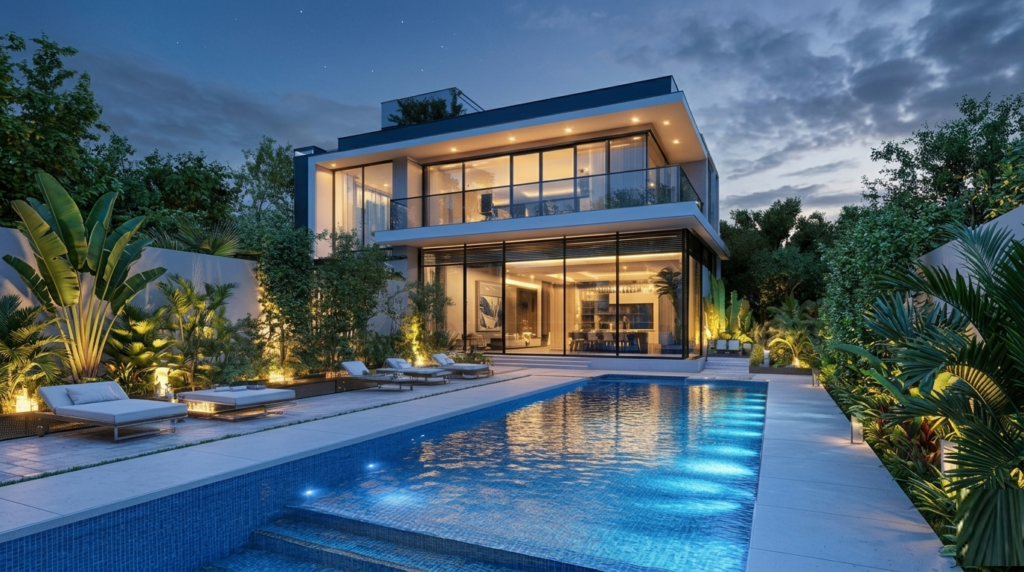
A villa pool designed with its garden. Shade, paving and planting all change what the pool costs to run.
Twelve build decisions that set the running cost
Every item below is fixed during design and construction. Some can be changed later, at a price. A few, like pipe sizes buried under the deck, are effectively permanent. This is the table we suggest you put in front of every contractor you are talking to.
| Decision | Cheap version | Version built for Dubai | What it changes every year |
|---|---|---|---|
| Pump | Single-speed pump, often oversized | Variable-speed pump sized to the design flow | Electricity, noise, seal wear |
| Pipe diameter | 50 mm throughout | 63 or 75 mm on suction and main return runs | Friction, so pump power for the same flow |
| Pipe route | Longest easy path, many elbows | Short runs, sweep bends, plant room close to the pool | Pump power and leak risk |
| Cover | None | Cover box built into the shell, or a planned roller position | Evaporation, top-up water, chemicals, dust in the water |
| Summer cooling | Not considered | Reversible heat pump or chiller sized to the volume, plus shade | How many months is the pool pleasant to use? |
| Filter | Small sand filter | Filter sized for Dubai dust, glass media or a regenerative filter | Backwash water, cloudy days, media replacement |
| Water treatment | Manual chlorine tablets | Salt chlorinator or ORP/PH dosing, with UV where it suits | Chemical spend, water comfort, service time |
| Waterproofing | Single coat, no flood test | Specified membrane system with a witnessed flood test | The chance of paying for a hidden leak |
| Finish | Basic plaster or thin tile with standard grout | Glass mosaic or quality tile with epoxy grout | Resurfacing interval, staining, grout loss |
| Lighting | Halogen fittings | LED fittings on a timer | Electricity and bulb changes |
| Skimmer position | Wherever the wall is convenient | Downwind of the prevailing northwesterly | How much debris the pool cleans itself of |
| Planting | Added later by someone else | Designed with the pool: shade on the west, low-litter species near the water | Water temperature, leaf load, filter cleaning |
Swipe the table sideways to see every column.
None of these is exotic. Most of the better version costs a few thousand dirhams more at the build stage. What they have in common is that a buyer comparing quotes on price alone will never see them, because they sit in the specification rather than the headline. A contractor who builds and walks away has little reason to spend that money. A contractor who will also maintain the pool has every reason to.
Pumps, pipes and the electricity bill
The pump is the biggest running cost on most private pools in Dubai, and it is also the easiest one to get wrong.
How much a pump actually costs to run
DEWA charges residential electricity in slabs of 23, 28, 32 and 38 fils per kWh, plus a fuel surcharge that has recently been around 6 fils. A villa with a pool and air conditioning in summer is usually in the upper slabs, so every extra kWh the pool uses is billed at the top rate. Using 32 fils plus 6 fils, call it 38 fils à unit.
A common builder’s pump is a 1.5 kW single-speed unit running eight hours a day. That is 12 kWh a day, about 4,380 kWh a year, or roughly AED 1,660 a year before VAT.
A variable-speed pump works differently. Pump power follows the cube of speed, so a pump running at half speed draws about one eighth of the power. In practice a well-set variable-speed pump runs long and slow, say sixteen hours at low speed with short high-speed periods for vacuuming and backwashing. Averaging around 0.25 kW, that is about 1,460 kWh a year, or roughly AED 550.
The difference is about AED 1,100 a year. Over fifteen years, before any tariff rise, that is more than AED 16,000 from one component. The variable-speed pump usually costs a few thousand dirhams more to buy.
🔢 The sum behind it
Single-speed: 1.5 kW x 8 h x 365 days = 4,380 kWh x AED 0.38 = about AED 1,660 a year. Variable-speed: 0.25 kW average x 16 h x 365 days = 1,460 kWh x AED 0.38 = about AED 555 a year. Your own figure depends on your slab and your settings, but the ratio holds.
Why pipe size matters as much as the pump
Water moving through a pipe loses energy to friction. Push the same flow through a narrow pipe, and the friction rises steeply, so the pump has to work harder. Many villa pools are plumbed in 50 mm pipe because it is cheap and easy to fit. Stepping the suction lines and main return up to 63 or 75 mm lets the pump deliver the same flow at a lower speed, which is where the variable-speed saving comes from. Put a good pump on the undersized pipe, and a lot of that savings disappears.
Pipe routes matter too. Every tight 90-degree elbow adds resistance. A plant room placed 25 metres away, because that corner was out of sight, adds resistance every metre. These pipes end up under the deck and garden. Changing them later means lifting paving.
Sizing to the Dubai Municipality turnover
Dubai Municipality’s technical guidelines for pool plans require the whole pool volume to pass through the filter within four hours. An 8 x 4 m pool averaging 1.5 m deep holds about 48 m³, so the system must be able to move about 12 m³ an hour. A good contractor sizes the pump and pipes to hit that flow comfortably at a moderate speed, then uses the variable-speed drive to run below it for much of the day and above it when the pool is busy. An oversized single-speed pump hits the number, but it burns power doing so and can push water through the filter too fast to catch fine dust.
Ask your contractor for the pump model, its curve and the design flow at the planned speed. If they cannot give you all three, the pump was chosen from a price list, not a calculation. Our note on hydraulic flow rate assessment shows how we check existing pools, and pump and motor diagnostics cover what fails when a pump is overworked.
Evaporation, top-up water and covers
Hot, dry, windy air pulls water out of a pool fast. American evaporation charts for desert conditions put summer losses at a centimetre or more a day in the worst weather. Dubai’s humidity is higher than Arizona’s, but the heat and the afternoon wind are comparable for much of the summer.
Take an 8 x 4 m pool, 32 m² of water surface. At 10 mm a day, that is 320 litres gone every day in peak summer. Averaged across a year at around 6 mm a day, the pool loses roughly 70 m³, which is more than its own volume.
The water itself is only part of the cost. Evaporation takes pure water and leaves everything else behind. Stabiliser, dissolved salts and calcium build up until the water has to be partly drained and refilled to bring the chemistry back. And Dubai’s desalinated top-up water is naturally low in calcium, so it tends to pull calcium out of plaster and cement grout as it settles. More top-up water means more of that.
What a cover does
Covers are the single strongest control on evaporation. Published figures for solar and automatic covers put the reduction at 85 to 95 per cent while the cover is on. A covered pool also collects far less dust and leaves, loses less chlorine to sunlight, and holds a cooler temperature through a summer afternoon.
The build decision is where the cover goes. An automatic slatted cover works best with a box or pit built into the shell or the deck at the start. Retrofitting one later often means cutting coping and adding an above-ground housing that nobody likes the look of. If a cover is even a possibility in the future, the contractor should design the position for it now. For the equipment choices, see energy-efficient pool solutions in Dubai.
Leaks that look like evaporation
Owners often blame the sun for a leak. The bucket test settles it: a bucket of pool water on the top step, marked inside and out, left for 24 hours with the pump on normal settings. If the pool drops faster than the bucket, the pool is leaking. A leak in buried pipework or behind a failed membrane usually traces back to construction. Our guide to detecting and repairing pool leaks in Dubai goes through the steps.
Summer heat, chillers and shade
In the UK and much of Australia, pool heating is the running-cost headline. In Dubai it runs the other way. From June to September an uncovered pool in full sun can climb well past body temperature. Families stop swimming, and the pool sits there, still running its pump and still taking its service visit.
There are three ways to deal with it, and they work best together.
Shade designed in, not bolted on
The cheapest cooling is keeping the sun off. A pergola, shade sail or tree canopy over the west end of the pool blocks the hardest afternoon sun. That needs thought at the design stage, because footings for a pergola sit close to the pool shell, and tree roots need to be kept away from pipework. Planting also has to be chosen with the filter in mind (more on that below).
Chillers and reversible heat pumps
A pool chiller, or a reversible heat pump that cools in summer and warms in the short winter, is the main mechanical answer. Modern inverter heat pumps move several units of heat for every unit of electricity. A unit drawing around 3 kW for six hours a day across a five-month summer uses about 2,700 kWh, roughly AED 1,000 a season at the top slab. That figure falls sharply if the pool is shaded and covered overnight, because the machine is fighting less incoming heat.
The build decisions are the position and size of the unit (it needs airflow and space in the plant room or a service yard), the plumbing connections, and the electrical supply. Adding a chiller to a pool that was never plumbed for one is possible, but it is more work. The trade-offs are covered in pool heating and cooling in Dubai and comparing pool heating options.
Colour and depth
Dark finishes look beautiful and absorb more heat. Very shallow pools heat faster than deep ones. Neither is wrong, but the owner should hear the trade-off before choosing, not in the first August.
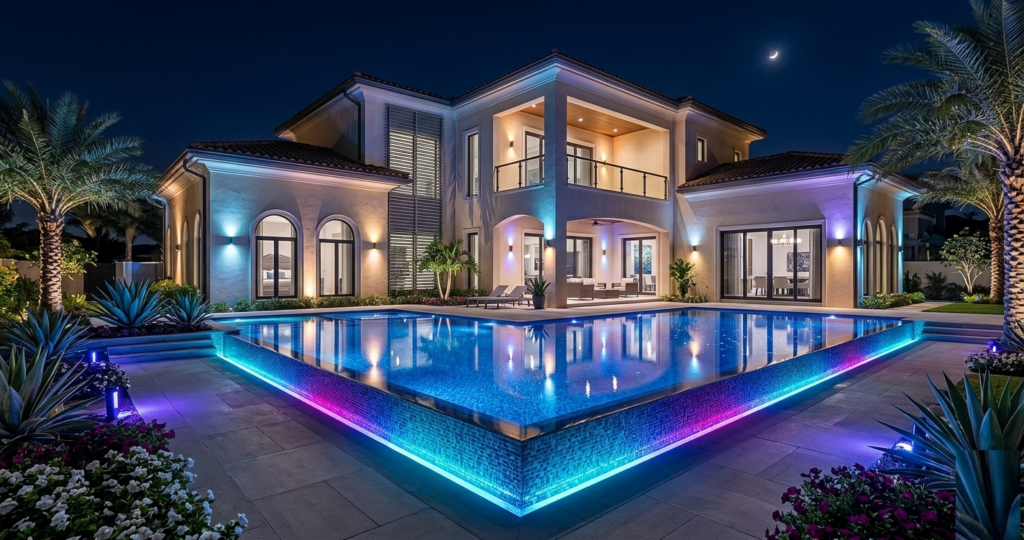
Planting and structures placed to cut afternoon sun on the water keep the pool usable for longer in summer.
Filters and the dust problem
Dubai dust is fine. After a shamal, a pool can take in more fine particulate in a day than a European pool sees in a month. So filtration here is a load problem first and a cleaning problem second. The filter has to catch very small particles without clogging so fast that it needs backwashing every other day.
| Filter type | How it cleans | Water used | Media life | Fit for Dubai villas |
|---|---|---|---|---|
| Sand | Backwash | High, several hundred litres per backwash | Replace sand every few years. | Works if sized generously. |
| Glass media | Backwash | Lower than sand, shorter backwash | Longer than sand | A good upgrade for dust |
| Cartridge | Remove and hose down. | Very little | Cartridges are replaced periodically. | Suits smaller pools with regular service |
| Regenerative media | Bump and re-coat, no backwash. | Minimal | Media replaced at long intervals | Fine filtration, higher purchase price |
Swipe the table sideways to see every column.
The build mistake we see most often is a filter that is too small for the pump. It was fine on the day of handover. Six months later, after a few dusty weeks, the pressure climbs quickly, the owner backwashes constantly, and the water still looks dull. The filter area should be matched to the design flow, with room to spare for dust.
There is more detail in pool filtration systems in Dubai, filtration system engineering and filter media maintenance.
Chlorine, salt, UV and automatic dosing
Water treatment is where the running cost is most visible to the owner, because it shows up as a chemical bill and as how the water feels on skin.
Manual chlorine
The cheapest to install. Tablets or liquid chlorine are added by hand or through a floater. In Dubai sun, unstabilised chlorine burns off fast, so stabiliser (cyanuric acid) is used. Evaporation then concentrates that stabiliser until the chlorine stops working well, which is the familiar story of a pool that “has chlorine” but still grows algae.
Salt chlorination
A salt cell makes chlorine from lightly salted water. Owners like the softer feel and the steady level. The running costs are electricity for the cell, salt top-ups, and a replacement cell every few years. The build decision is a material choice. Salt water is harder on some metals and natural stone, so coping, fixings and ladders should be specified for it from the start. Saltwater pools in Dubai explains the switch in more depth.
UV and ozone
These sit in the pipework and kill organisms as water passes through. They do not replace chlorine, but they cut the amount needed. They are easiest to fit during construction, when there is space on the pipe run.
Automatic dosing with probes
An ORP and pH controller reads the water continuously and doses chlorine and acid to hold the targets. This is standard on commercial pools and increasingly common on villas. It cuts waste, because the controller doses what the water needs instead of what a routine says. The probes need calibrating, which is part of the annual review we carry out. For the chemistry targets themselves, see water chemistry management and controlled chemical dosing.
Shell, waterproofing and finish life
The most expensive repair a pool can need is one behind the tiles. A failed membrane or a cracked shell means draining, stripping and rebuilding a section of the pool. That is why the structural decisions sit in a running-cost guide at all.
Shell
Most Dubai villa pools use a reinforced concrete shell, either cast in formwork or sprayed. The details that matter over twenty years are concrete grade and cover to the steel (Dubai ground can carry chlorides and sulphates that attack reinforcement), and, on plots near the coast or on reclaimed land, protection against groundwater pushing an empty pool upwards. You cannot see any of this after handover. Ask for the structural drawings and the concrete test results.
Waterproofing
The membrane should be a named system applied to the manufacturer’s method, with extra detailing at every pipe penetration, light niche and skimmer. Then the shell should be filled and held for a flood test before any tile goes on, with the owner or their consultant invited to see it. Our guide to torch membrane waterproofing covers the method in full.
Finish
| Finish | Typical life in Dubai conditions | What shortens it? | What renewal involves |
|---|---|---|---|
| Standard plaster | Often 7 to 12 years before resurfacing | Soft, low-calcium water, poor chemistry, etching | Drain, acid wash or strip, replaster |
| Pebble or quartz aggregate | Longer than plain plaster | Same chemistry issues, more slowly | Drain and resurface |
| Ceramic or porcelain tile | Long, if the grout holds | Cement grout washed out by soft water | Re-grout sections, replace lifted tiles. |
| Glass mosaic with epoxy grout | The longest-lasting common finish | Poor adhesive coverage at installation | Spot repairs, often underwater |
Swipe the table sideways to see every column.
Grout is the detail most buyers miss. Cement grout is cheaper, and it looks the same on handover day. In Dubai’s soft top-up water, it slowly dissolves, tiles start to rattle, and small leaks follow. Epoxy grout costs more and takes longer to lay. It is one of the clearest examples of the second bill being written on the first day. See choosing pool tiles in Dubai and what the best contractors specify for tiling.
The plant room nobody looks at.
The plant room holds the pump, filter, controls, dosing equipment and sometimes the chiller. Owners rarely visit it. Builders often put it wherever space is left over. It has a surprisingly large effect on running cost.
- Distance. Every metre between plant room and pool adds friction, so pump power. Close is better.
- Heat. An unventilated room in a Dubai summer can get well past 50°C. Motors, control boards and salt cell power supplies all fail sooner in that heat.
- Access. If the technician has to crawl in, the filter gets cleaned less carefully, and valves get forced. A plant room with standing room and light is serviced better.
- Drainage. Backwash water and any leak need somewhere to go. A flooded plant room kills a pump.
- Space for later. Room left for a chiller, UV unit or dosing controller makes a later upgrade a morning’s work instead of a rebuild.
- Noise. A pump next to a bedroom window will be run less or complained about. Position it with the house plan in mind.
When we audit an existing pool, the plant room tells us most of the story within ten minutes. Our page on keeping pool equipment in shape has the owner’s checklist.
Designing the pool and garden together
Green Creation started as a landscaping company and added pools afterwards. That order still shapes how we work, because we treat the pool and the garden around it as one design. In running-cost terms this matters more than most people expect.
Trees and litter
A tree that drops fine leaves or flowers over the water all year adds a steady load to the skimmer and filter. Some popular Dubai garden species are heavy shedders. Others give good shade with little litter. We choose and place planting knowing where the skimmers are and which way the wind blows.
Wind and skimmers
Dubai’s prevailing wind is broadly from the north-west. Skimmers placed on the downwind wall let the wind push floating debris to them. Put them on the upwind side, and debris piles up in a far corner until someone nets it.
Irrigation and splash
Irrigation overspray and runoff carry fertiliser and soil into the pool, which feeds algae and upsets the chemistry. Deck falls, drainage channels and the irrigation layout should be designed together so garden water goes to the garden drains. Dubai Municipality’s pool guidelines already call for decks to fall away from the pool, and we extend that thinking to the planting beds.
Paving and heat
Dark stone around a pool gets hot enough to burn feet in summer and radiates heat back at the water. Lighter, cooler paving and some planted edges make the whole area usable for longer. The pool landscaping guide and transforming Dubai gardens show examples.
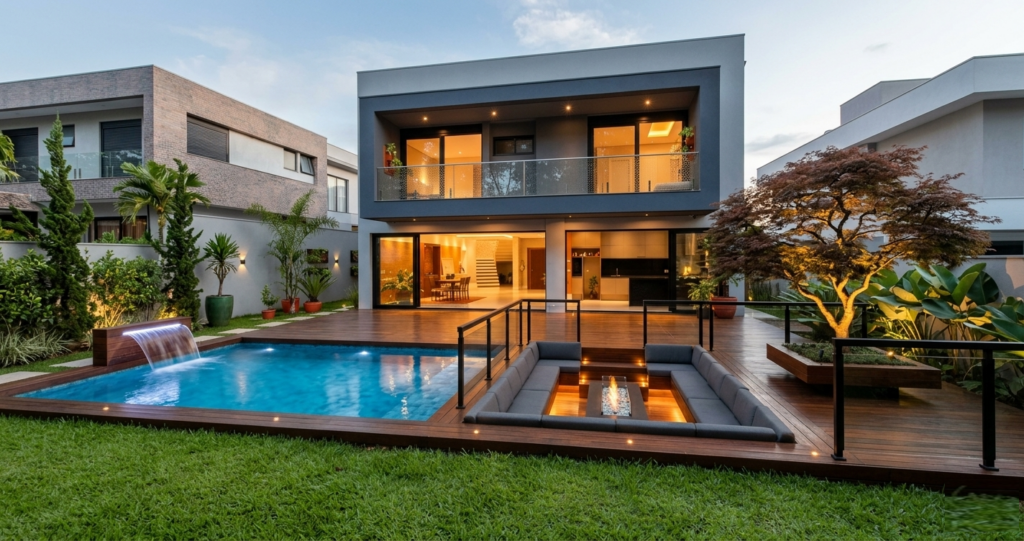
Pool, paving and planting laid out as one plan, with skimmers, shade and drainage thought through together.
A twenty-year cost picture for an 8 x 4 m pool
The table below compares two versions of the same 8 x 4 m villa pool, about 48 m³. One is built to the lowest reasonable specification. The other is built with the choices described above. Electricity figures are calculated at 38 pence per kWh. Other rows are described rather than priced because they depend heavily on the product chosen and how the pool is used. Treat this as a way to think about the numbers, not as a quotation.
| Item | Lowest-spec build | Built for Dubai |
|---|---|---|
| Pump electricity per year | About AED 1,660 (1.5 kW single-speed, 8 h/day) | About AED 555 (variable-speed, 0.25 kW average, 16 h/day) |
| Pump electricity over 20 years | About AED 33,200 | About AED 11,100 |
| Pool lights per year (4 h/night) | About AED 165 (300 W halogen) | About AED 20 (35 W LED) |
| Evaporation per year | Roughly 70 m³ uncovered | A fraction of that when a cover is used daily |
| Partial drain-and-refill for chemistry | More frequent, as stabiliser builds up | Less frequent with a cover and automatic dosing |
| Chemicals | Higher, manual dosing, sunlight losses | Lower, dosed to demand, UV or salt support |
| Filter | Frequent backwash, sand changes | Fewer backwashings, longer media life |
| Surface | Plaster resurfacing is likely once or twice in 20 years. | Glass mosaic with epoxy grout, spot repairs |
| Leak risk | Higher without a witnessed flood test | Lower, tested before tiling |
| Months the pool is comfortable | Often too warm from late June to September | Usable most of the year with shade and a chiller |
Swipe the table sideways to see every column.
The pump and lights alone come to more than AED 24,000 in the owner’s favour over twenty years. That is before counting the surface, the water, the chemicals and the value of actually swimming in August. The extra build cost of the Dubai-ready version is usually well below that.
For the maintenance side of the same picture, see the cost of pool maintenance in Dubai and how to reduce pool maintenance costs.
Swimming pool construction Dubai prices and timelines
Running costs are only half the decision, so here are the build figures. These are market ranges gathered from Dubai quotes and published cost guides for villa pools, excluding VAT. They are not a Green Creation price list. Your quote will depend on access, soil, finish and garden scope.
| Pool type | Typical build range (AED) | Running-cost notes |
|---|---|---|
| Plunge pool | 55,000 to 120,000 | Small volume, cheap to run, heats up fast in summer |
| Fibreglass shell | 75,000 to 180,000 | Smooth finish, fewer chemicals, size limited by transport |
| 6 x 3 m concrete | 90,000 to 170,000 | The common starter villa pool |
| 8 x 4 m concrete | 120,000 to 230,000 | The example used in this guide |
| Lap pool | 180,000 to 500,000 | Long and narrow, high surface area for evaporation |
| Infinity edge | 280,000 to 500,000 and up | Balance tank and extra pump, higher water and power use |
Swipe the table sideways to see every column.
How long does a build take?
For a standard villa pool, allow a few weeks for design and approvals and then roughly 10 to 16 weeks on site. Dubai Municipality approvals on mainland plots often take 7 to 15 working days once drawings are complete. Community projects add a master developer NOC before the permit. Summer works run around the midday break, and hot-weather concreting is scheduled for early morning. Infinity, rooftop and indoor pools take longer. Our step-by-step construction guide for villa owners walks through each stage, and the cost of building a pool in Dubai breaks the budget down further.

A completed Green Creation pool. Pipe sizes, plant room position and finish were all set before excavation began.
Dubai rules that affect running costs
Several Dubai Municipality requirements for pool plans have a direct link to what the pool costs to run. A contractor who designs for them from the first sketch avoids expensive redesigns at the approval stage.
- Four-hour turnover. The filtration system must be able to pass the full pool volume through the filter in four hours. This sets the minimum design flow, so the pump and pipe are sized accordingly.
- Inlets. The guidelines call for at least one inlet per 45 m³ of water, which affects how evenly treated water reaches every corner.
- Skimmers and main drains. Minimum numbers are set, and main drains must be protected against entrapment.
- Deck fall. Decks fall away from the pool (about 1 in 40), which keeps garden and deck runoff out of the water.
- Barrier. A barrier around 1.2 m high is required around the pool. Its position affects where the cover, chiller and plant room can go.
- Automatic dosing. For public and communal pools, automated dosing is required. Many villa owners choose it too.
Pools in free zones and some master communities fall under other authorities, such as Trakhees or the Dubai Development Authority, and communal pools have logbook and water-testing duties. The full picture is in Dubai Municipality pool permits, pool permits and regulations and swimming pool compliance in Dubai.
Types of pool contractors in Dubai
“Pool contractor” covers several different kinds of business in Dubai. Knowing which one you are talking to explains a lot about how they will treat the running-cost questions.
Design-and-build pool companies
They take the project from concept drawings through approvals, construction and commissioning. The better ones also offer maintenance. This is the model that gives one company responsibility for how the pool performs.
Build-only contractors
They build to someone else’s drawings, often as a subcontractor to a villa’s main contractor. Quality can be good, but the running-cost decisions were made by whoever drew the pool, sometimes an architect with no pool service experience.
Landscaping firms that add pools
Strong on the garden, sometimes weaker on hydraulics and waterproofing. Worth checking who actually designs and builds the pool itself.
Maintenance companies that also build
They know running costs well because they live with them. Check their structural and waterproofing experience before trusting them with a new shell.
Green Creation sits across all four. We work as a turnkey design-and-build contractor, as a pool subcontractor to main contractors, as a landscaping company, and as a maintenance company with our own engineers. That combination is uncommon in Dubai, and it is why our designs look at the second bill. Our guides on comparing services offered by Dubai pool contractors and what to evaluate when comparing pool builders cover the wider checks.
Questions to ask pool contractors in Dubai before you sign
These are running-cost questions. They sit alongside the usual checks on licence, insurance, references and payment schedule, which we cover in critical questions to ask before hiring.
- Which pump model are you proposing? Is it variable-speed, and what flow will it give at the planned running speed?
- What pipe diameters are you using on suction and return, and how far is the plant room from the pool?
- What is the design flow against the four-hour turnover for this volume?
- What filter area and which media are you proposing for this flow?
- Where would a cover go, and are you building the box or position for it now?
- How will the pool be kept usable from June to September? Shade, chiller, or both?
- Which waterproofing system, and when will the flood test happen? Can I attend?
- Which finish and which grout, and how long do you expect them to last in Dubai water?
- What water treatment do you recommend, and what will it cost to run each year?
- Who maintains the pool after handover, and will the builder stand behind the running costs they designed?
A contractor who answers these with model numbers and figures has designed the pool. One who answers with “Don’t worry, it’s all standard” has priced it.
Why Green Creation builds this way
Green Creation has built and looked after pools and gardens in Dubai for close to two decades. Our work covers villas in Palm Jumeirah, Arabian Ranches, Jumeirah Village Circle, Dubai Hills and Al Barsha, and commercial projects for clients including Emaar, Meraas, Sobha, Deyaar, Hilton and Azizi, up to Olympic-size pools.
We maintain what we build.
Our maintenance team services our own pools and pools built by others, on weekly, fortnightly and monthly plans. So when we choose a pump or a grout, we are choosing something our own technicians will live with. That changes decisions. It is the main reason our specifications lean towards the Dubai-ready column of the tables above.
Engineers who work underwater
Our commercial divers are qualified pool engineers. They can repair tiles, fittings and some leaks underwater without draining the pool. For an owner, that means less water wasted and no weeks of an empty shell exposed to the sun.
An audit before any quote
For maintenance and renovation, we start with a pool audit that includes a test of the fill water, because Dubai top-up water varies, and it affects every chemistry decision after that. Once a year we review each pool we maintain: pump curve, filter condition, controller calibration and any dosing or automation that would pay for itself. More on this in preventive pool maintenance planning.
Every cost agreed in writing
We agree on each design detail and the cost of each component with the client or their architect before work starts. Owners know which pump, which filter, which membrane and which finish they are paying for. That makes the running-cost questions in the previous section easy to answer, because the answers are already on paper.
Turnkey, or part of a bigger team
We can deliver the pool and garden as a single turnkey project or join a main contractor’s team as the pool specialist. Either way, the design approach is the same. We also design and service hot tubs, saunas and steam rooms, so a wellness area can come from one company.
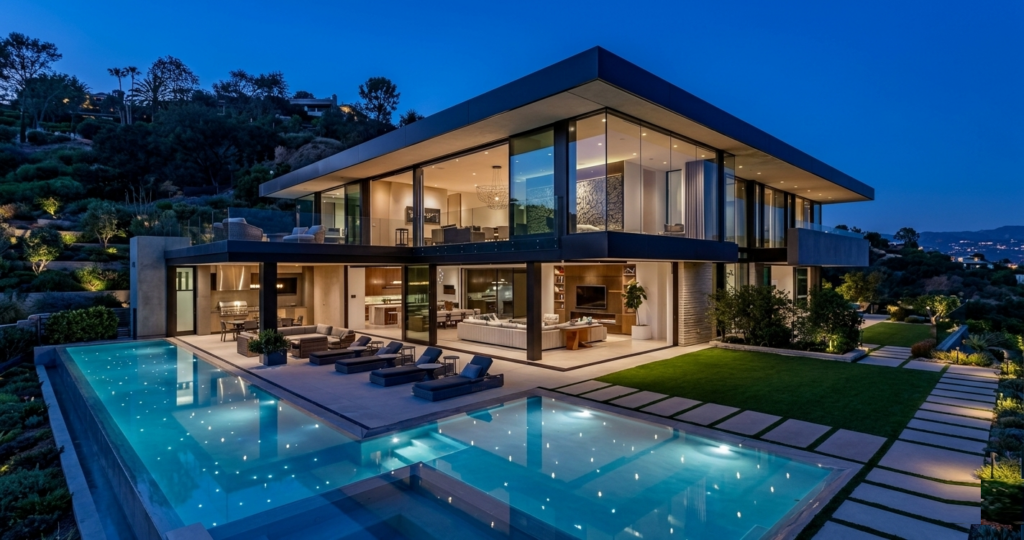
LED lighting, a close plant room and a finish chosen for Dubai water keep this pool’s running costs low.
You can see finished work in our project gallery, read about Green Creation, or look through our services. Our main pages for swimming pool contractor work, pool builders in Dubai and pool design in Dubai have more detail.
Further reading
Construction and choosing a contractor:
- Swimming pool construction in Dubai, costs, materials and timelines
- Step-by-step pool construction process in Dubai
- What to expect during pool construction
- Preparing your property for a pool installation
- How to plan a swimming pool in Dubai
- How to choose the best swimming pool contractor in Dubai
- Pool contractors in Dubai, a guide for homeowners and developers
- What you must know before signing a pool contract
- Avoiding common pitfalls when hiring pool professionals
- Pool construction mistakes to avoid in Dubai
- Quality and safety in pool construction
- Comparing pool construction materials for Dubai’s climate
- Choosing the best materials for your pool
- Costs of pool installation in Dubai
- Budget vs high-end pools in Dubai
- What a pool adds to property value in Dubai
Pool types and features:
- Infinity pools in Dubai
- Rooftop pools in Dubai
- Indoor pools in Dubai
- Lap pools and plunge pools
- Commercial pool construction
- Luxury pools in Dubai
- Custom pools by Green Creation
- Smart pool technology in Dubai
- Pool water features
- Pool safety standards in Dubai
- Sustainable pool design, saving water and energy
- Eco-friendly pool construction in Dubai
- Dubai communities for private pools
Maintenance, repair and renovation:
- Pool maintenance in Dubai
- Villa pool maintenance
- Commercial pool maintenance
- Weekly pool cleaning service
- Pool water testing and analysis
- pH and alkalinity stabilisation
- Algae prevention
- Environmental pool maintenance
- Structural and surface integrity checks
- Seasonal maintenance checklist for Dubai
- Preparing your pool for summer
- Annual maintenance contracts
- Swimming pool repair
- Saltwater pool repair
- Fixing leaks, cracks and equipment faults
- Pool renovation in Dubai
- Cost-effective repairs and upgrades
Frequently asked questions
Who are the best swimming pool contractors in Dubai?
The best ones are designed for the whole life of the pool and can back it with figures: pump model and flow, pipe sizes, filter area, waterproofing system, finish, and a plan for summer heat and evaporation. They also stay involved after handover. Green Creation designs, builds and maintains pools with its own engineers and divers, and has completed 8,940 projects for more than 5,500 clients.
How much does swimming pool construction in Dubai cost?
Market ranges for villa pools run from about AED 55,000 for a plunge pool to AED 120,000 to 230,000 for a typical 8 x 4 m concrete pool and AED 280,000 or more for an infinity edge, excluding VAT. Access, soil conditions, finish and how much garden work is included all move the price.
How much does it cost to run a pool in Dubai each year?
For an 8 x 4 m pool, pump electricity alone ranges from about AED 550 a year with a well-set variable-speed pump to about AED 1,660 with a typical single-speed pump, at top-slab DEWA rates. Add lights, top-up water, chemicals, service and any chiller. The build specification decides a large part of this total.
How long does it take to build a pool in Dubai?
A standard villa pool usually takes 10 to 16 weeks on site after approvals. Design and permits add a few weeks before that. Infinity, rooftop and indoor pools take longer, and summer working hours can stretch the programme slightly.
Do I need a permit to build a pool at my villa in Dubai?
Yes. Mainland plots need Dubai Municipality approval of the pool plans. Villas in master communities also need a no-objection certificate from the developer, and some areas fall under Trakhees or the Dubai Development Authority instead. Your contractor should prepare and submit the drawings.
Is a variable-speed pump worth the extra cost?
For most Dubai pools, yes. Running slowly for longer uses far less power because pump power drops with the cube of speed. On an 8 x 4 m pool the saving is often around AED 1,000 a year, which pays back the price difference within a few years. It works best with properly sized pipes.
Should I choose a salt or chlorine pool in Dubai?
Salt chlorination gives steadier chlorine and softer-feeling water, and many owners prefer it. It costs more to install and needs a replacement cell every few years. Metals and stone around the pool should be chosen to suit salt water from the start. Manual chlorine is cheaper to set up but needs more attention in the summer sun.
Do I need a pool chiller in Dubai?
If you want to swim comfortably from late June to September, usually yes, unless the pool is well shaded. A reversible heat pump cools in summer and warms in winter. Shade and a cover reduce how hard it has to work, so plan all three together.
How much water does a pool lose to evaporation in Dubai?
In peak summer, around a centimetre a day is common for an uncovered pool in sun and wind. For an 8 x 4 m pool, that is about 320 litres a day and roughly 70 m³ across a year. A cover used daily cuts evaporation by most of that.
Which pool finish lasts longest in Dubai?
Glass mosaic laid with full adhesive coverage and epoxy grout generally lasts the longest. Plain plaster often needs resurfacing within about 7 to 12 years, because Dubai’s soft desalinated water tends to draw calcium out of it.
Is a sand, glass or cartridge filter better for a Dubai pool?
All three can work if the filter is sized properly for the flow and the dust. Glass media usually outperforms sand on fine Dubai dust and uses less backwash water. Cartridges suit smaller pools with regular service. Regenerative media filters give the finest filtration but cost more.
What should a pool contractor hand over at completion?
As-built drawings with pipe routes, equipment models and manuals, the waterproofing and flood test records, the approvals, warranty terms, and the settings for the pump, dosing and controls. Without these, future repairs and maintenance cost more.
Can the same company build and maintain my pool?
Yes, and it usually works in your favour. A builder that also maintains has to live with its own design choices. Green Creation offers weekly, fortnightly and monthly maintenance for its own pools and pools built by others.
What is the difference between a pool contractor and a pool construction company?
In Dubai the terms overlap. A pool construction company usually handles the build itself, while a pool contractor may also design, get approvals, subcontract parts of the work, or maintain the pool. Ask exactly which stages the company does with its own staff.
How do I compare quotes from pool contractors in Dubai?
Put the quotes side by side on specification as well as price: pump model and flow, pipe sizes, filter, waterproofing system and flood test, finish and grout, water treatment and cooling. Two quotes with the same total can hand over pools with very different running costs.
Can a pool be built on a rooftop or podium in Dubai?
Yes, with a structural engineer’s approval of the slab and careful waterproofing, since a leak ends up in the rooms below. Plant rooms on roofs need good ventilation because of the heat.
Does Green Creation work as a subcontractor for main contractors?
Yes. Green Creation delivers turnkey pool and garden projects and also works as the pool specialist on projects led by main contractors, agreeing every design detail and component cost with the client or architect first.
Which areas of Dubai does Green Creation cover?
All of Dubai, with regular residential work in Palm Jumeirah, Arabian Ranches, Jumeirah Village Circle, Dubai Hills and Al Barsha, and commercial projects across the UAE.
Plan a pool that is cheaper to own.
Talk to Green Creation about design, construction or a running-cost review of your existing pool. Call +971 50 948 4081 from 9am to 6pm.
Running-cost figures are worked examples using DEWA residential slab rates and a fuel surcharge of about 6 fils per kWh. Your bill depends on your slab, equipment and settings. Build prices are market ranges, not a quotation.