
Swimming pool contractors in Dubai measured against British, American and Australian build standards
Most advice on choosing a pool builder in Dubai stops at “check their reviews”. This guide does something harder. It takes the published pool-building rules from the United Kingdom, the United States and Australia, lays them next to Dubai Municipality’s own, and turns the differences into questions you can put to any contractor before you sign.
⚡ Short answer
The best swimming pool contractors in Dubai build to Dubai Municipality’s rules and then go further where foreign standards are stricter. In practice that means shell concrete of at least 27.6 MPa, wet curing for a minimum of seven days, a witnessed water test before any tile goes on, two suction outlets with rated covers, a 1.2 m barrier with a self-closing gate, and a pump sized to turn the whole pool over in four hours or less. Green Creation prices each of those as a named line, so you can check them one by one.
📋 What is in this guide?
- Why a Dubai pool should be judged against foreign rulebooks
- Four rulebooks side by side
- The shell and what American shotcrete practice teaches
- Curing in forty-five-degree heat
- The water test and what British practice adds
- Drains and suction and the American lesson
- Fences and gates and the Australian lesson
- Circulation where Dubai’s own rules lead
- Pumps and power and what the American efficiency rule changed
- Who stands behind the pool in each country
- How to use the benchmark when you collect quotes
- Fourteen questions and what a good answer sounds like
- What no foreign rulebook covers
- Why Green Creation is the contractor we would measure others against
- How we differ from a typical competitor
- What building costs more than the higher standard
- After handover, when the builder’s work is tested
- Further reading on green-creation.com
- Frequently asked questions
Why a Dubai pool should be judged against foreign rulebooks
Dubai Municipality publishes technical guidelines for pool plans. They are good, and they are the law here. A contractor who ignores them will not get a permit.
But they are a floor. They tell a builder how many inlets a pool needs and how steep the floor can be. They say far less about how long fresh concrete must be kept wet, how a drain cover should be rated, or how a gate latch must behave when a three-year-old pushes on it.
Britain, America and Australia have written those details down. Each country learned them the expensive way. American drain rules exist because children were trapped on single suction outlets. Australian fence rules exist because toddlers drowned in back gardens. British water-test rules came out of reservoirs and tanks that leaked.
There is a second reason, and it is practical. Open the door of almost any plant room in Dubai and read the labels. The pump, the filter, the drain covers and the salt cell were very likely designed in one of those three countries and tested to one of those three sets of standards. So the equipment already carries the rules with it. The only open question is whether the people installing it follow them.
That is the real difference between ordinary pool contractors in Dubai and good ones. Both will pass inspection. Only one of them can tell you the compressive strength of your shell and show you the test sheet.
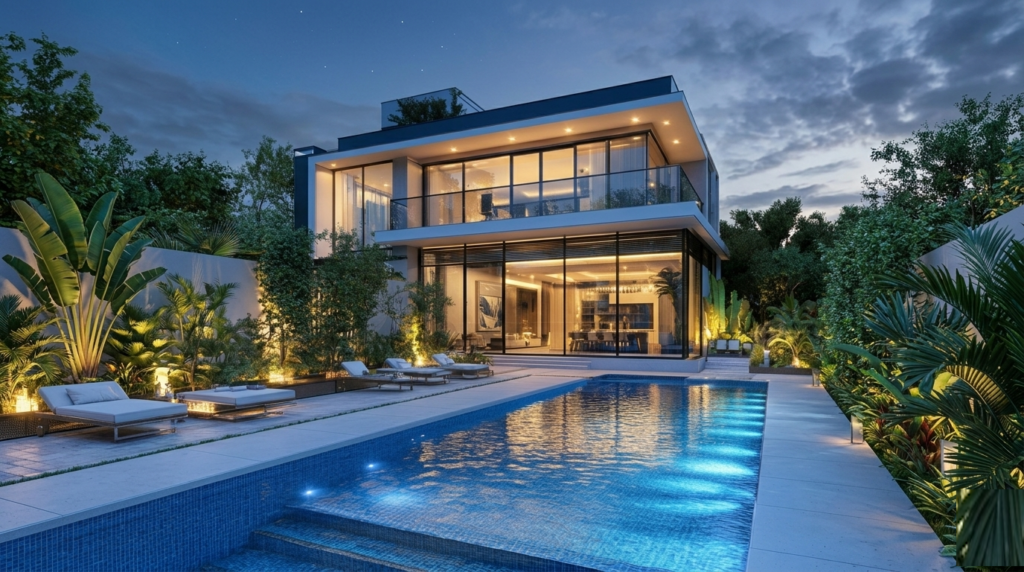
A finished villa pool by Green Creation. What decides how long it lasts is underneath the tile.
Four rulebooks side by side
The table below is the heart of this guide. Each row is one part of a pool. Each column shows what a different country expects. The last column is the question to ask.
Nobody is asking a Dubai builder to hold a British trade membership. The point is simpler. Where another country sets a tougher number, and the number costs little to meet, you should expect it in your contract.
| Part of the pool | Dubai Municipality | United Kingdom | United States | Australia | Ask your contractor |
|---|---|---|---|---|---|
| Shell strength | The engineer’s structural design was approved with the permit. | Designed as a water-retaining structure under the British and European concrete codes | American Shotcrete Association minimum of 4,000 psi (27.6 MPa) in place | AS 2783 covers concrete pool design. | What strength is specified, and who tests it? |
| Curing | Left to the engineer | Kept damp as the designer directs | Continuously moist for at least 7 days, then daily for days 28 | Follows the concrete structure code | How many days will the shell be kept wet, and by whom? |
| Water test | Expected before finishing | Long-standing test of 7 days to settle and 7 days measured | The bare-shell fill test is common practice. | Common practice | Will I be invited to read the level on day one and the last day? |
| Suction outlets | Two main drains | Covers tested under the European pool equipment standards | Federal drain law plus ANSI/APSP-7 and ANSI/APSP-16 | AS 1926.3 on recirculation and entrapment | Are there two outlets, and what rating is stamped on the covers? |
| Barrier | About 1.2 m around the pool | Strongly advised, not a national law for private gardens | 48 inches (1.22 m) under the model pool code | 1.2 m with a 900 mm non-climbable zone under AS 1926.1 | Does the gate close and latch by itself from any position? |
| Turnover | Whole volume in 4 hours | Set by pool type under industry guidance | Set by state health code for public pools | Set by state health rules | What is the measured flow in cubic metres per hour? |
| Inlets and skimmers | 1 inlet per 45 cubic metres, 2 skimmers | Sized by the designer | Sized by the designer | Sized by the designer | Where are they on the drawing? |
| Pumps | Two pumps | No fixed number for home pools | Federal efficiency rule favours variable speed | Energy rating labels on pumps | Is the pump variable speed, and what model is it? |
| Deck | 1 m wide on a private pool with a 1:40 fall | Slip-rated surfaces | Slip-resistant decking | Slip-rated surfaces | Which way does the deck drain? |
| Builder accountability | Trade licence, approved drawings, structural liability under UAE law | Trade body code of ethics and published standards | Voluntary builder certification and state licensing | State builder licence and, in several states, insurance on larger jobs | What do I hold in writing if you stop trading? |
Swipe the table sideways to see every column.
Read across any row, and a pattern shows up. Dubai is strict on hydraulics. America is strict on concrete and drains. Australia is strict on fences. Britain is strict on proving the shell holds water. A pool that borrows the hardest line from each is a very good pool.
The shell and what American shotcrete practice teaches
Most concrete pools in Dubai are either sprayed or cast in formwork. Sprayed concrete goes by two names, shotcrete and gunite, and American builders have used it for pools longer than anyone.
Their trade body, the American Shotcrete Association, has a position that is short and blunt. Pool concrete should reach at least 4,000 psi in place. That is 27.6 MPa. The same figure appears in the American concrete code for structures that sit in contact with water, along with a cap on the water-to-cement ratio of 0.50.
The association goes further. It says properly placed shotcrete normally reaches 4,500 to 9,000 psi, so a result under 4,000 means something went wrong with the mix or the crew. And it warns that writing a lower number into a contract shortchanges the owner.
Why does this matter in Dubai? Because weak concrete is porous concrete. Our groundwater in many coastal districts carries salt. Salt that gets through the shell reaches the steel, the steel rusts and swells, and the tile above it cracks. A dense shell slows that down by years.
So ask for the number. A sound specification names the grade, the cover to the steel, and the lab that will crush the test cubes or cores. A weak one says “reinforced concrete as per standard”. There is no such standard.
How the shell is placed matters as much as the mix.
Sprayed concrete leaves the nozzle at more than 100 metres per second. That speed is what packs it tight around the bars. A nozzleman who stands too far back, or sprays at a shallow angle, leaves soft pockets behind the steel that no inspector will see once the wall is finished.
The loose material that bounces off, called rebound, is another test of a crew. It should be shovelled out and thrown away. Crews in a hurry sweep it onto the floor or the steps, where it sets into a weak, sandy layer under your tile.
You do not need to be an engineer to check this. Visit on the day the shell is sprayed and watch what happens to the rebound. Our article on the step-by-step pool construction process explains what each stage should look like, and the guide to choosing pool materials compares sprayed concrete with cast walls and block.
Curing in forty-five-degree heat
Curing is the dullest part of a pool build and the easiest place to cut a corner. Nobody photographs it.
Concrete hardens by a chemical reaction with water, and that reaction needs the surface to stay wet. Let the surface dry out in the first week, and the outer layer never reaches full strength. It dusts, it crazes, and it lets water through.
American guidance for pool shells is specific. Keep the concrete continuously moist for at least seven days, soaking it three to five times a day or more. From day seven to day twenty-eight, we wet it at least once a day. If the pool will get a plaster finish, the plastering trade there recommends moist curing for the full twenty-eight days.
Now think about a Dubai summer. Air at 45 degrees, a dry wind, and a grey shell in full sun. A wall that would stay damp for hours in Sydney is bone dry here in twenty minutes. Three soakings a day is not enough. Good crews cover the shell with wet hessian or plastic sheet, and they put a named person in charge of the hose.
The same American guidance lists what heat does to fresh concrete. It needs more water, it stiffens faster, and it can set before the crew has finished shaping it. That is why careful builders here spray or pour in the early morning or at night between June and September. The UAE midday work ban, which stops outdoor labour from 12.30pm to 3pm in the hottest months, pushes the same way.
⚠️ A question worth asking twice
Ask who will wet the shell on a Friday. A contractor with a real curing plan will name the person. One without a plan will tell you the concrete “cures by itself”.
Our piece on construction mistakes to avoid covers what skipped curing looks like three years later.
The water test and what British practice adds
British engineers have built water tanks and reservoirs for a very long time, and they have an old, plain test for whether a concrete box holds water. Fill it. Wait. Measure.
The classic British method gives the structure seven days to soak, because new concrete drinks a little water at first. Then the level is marked and watched for a further seven days. The allowed drop over that week is tiny. It is one five-hundredth of the average water depth, or 10 mm, whichever is smaller.
Put that on a typical villa pool. Average depth 1.4 m. One five-hundredth of that is 2.8 mm. Less than three millimetres in a week.
In Dubai there is a catch. An open pool here can lose more than that to evaporation in a single afternoon. So the test needs a control. A bucket or a drum is filled with the same water and stands on the pool step in the same sun and wind. The drop in the bucket is evaporation. Any extra drop in the pool is a leak.
This is the moment the whole build turns on. Once the tile is on, a leak in the shell or around a pipe means breaking finished work to find it. Before the tile, it means a morning with a bag of repair mortar.
- Ask for the water test to be written into the contract as a stage you attend.
- Ask for the start level and end level to be photographed against a fixed mark.
- Ask that no waterproofing or tile be ordered to the site until you have signed the result.
- Ask what happens to the programme and the payment stage if the test fails.
Waterproofing comes after the bare-shell test and gets a second test of its own. The weak spots are never the flat walls. They are the places where something passes through the concrete, such as inlets, lights, skimmer throats and the main drains. Our guide to torch membrane waterproofing deals with roofs and podiums, and the article on finding and repairing pool leaks shows the bucket method in use on an older pool.
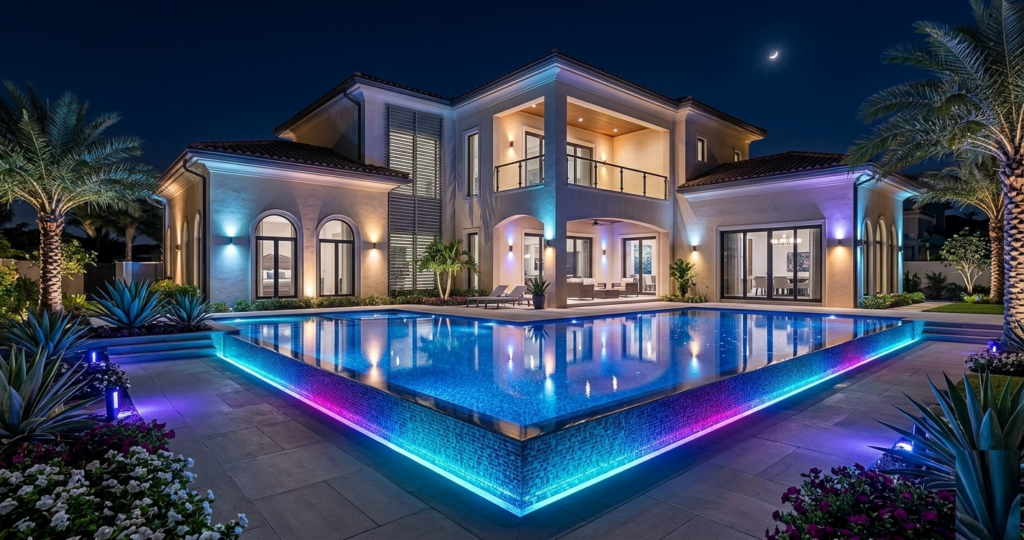
Tile hides everything behind it. The water test has to happen before this stage.
Drains, suction, and the American lesson
This section is short, and it is the most serious one in the guide.
A pool pump pulls water through outlets in the floor or wall. If a single outlet is the only path to the pump, and a person covers it, the pump pulls on the person. American safety bodies list five ways this goes wrong. Hair gets drawn in and knotted. An arm or leg gets stuck. A body seals against the cover. A child sitting on an open outlet suffers internal injury. Or a finger, a toe, a necklace or a swimsuit string gets caught in the grate.
The United States passed a federal law after a seven-year-old girl died this way. It set a standard for every drain cover sold in the country and made public pool retrofits. The American pool trade’s own guidance is blunt about covers, saying there is no backup for one that is broken, missing or wrong for the pipe.
Three things follow for a pool in Dubai.
- Two outlets, spaced apart, piped so that blocking one leaves the other open. Dubai Municipality already has two main drains. Check they are on the drawing and that they are not sitting side by side.
- Covers with a rating stamped on them. The stamp shows the maximum flow the cover is safe for. That figure has to be higher than what your pump can pull.
- A replacement date. Plastic covers go brittle in sun and chlorine. The maker stamps a service life on each one. Almost nobody in Dubai replaces them on time.
Australia covers the same ground in a separate part of its pool safety standard, which deals with water recirculation and entrapment. So three of our four rulebooks agree here. When you compare swimming pool construction companies in Dubai, ask each one for the drain cover model and its flow rating. A blank look is an answer too.
Our pages on pool safety standards and features and what every pool owner needs to know about safety go deeper on this.
Fences and gates and the Australian lesson
Australia has more home pools per person than almost anywhere, and it has the toughest fence rules to match. Their pool barrier standard, AS 1926.1, is worth reading even if you never set foot there, because it was written by people who measured how small children climb.
The main numbers are easy to remember.
- The barrier is at least 1.2 m high all the way round.
- Gaps between upright bars are no wider than 100 mm. So is the gap under the fence.
- A 900 mm zone on the outside has nothing in it a child could use as a step. No rails, no planters, no air-conditioning unit, no tree.
- If a boundary wall forms part of the barrier, it is at least 1.8 m high.
- Gates swing outward, away from the water. They close themselves from any position, and they latch themselves without anyone pushing.
America’s model pool code sets 48 inches, which is 1.22 m. Dubai Municipality asks for about 1.2 m too. So the height is the same in three countries. What Australia adds is the detail about climbing and gates, and those are the parts that fail in real gardens.
Walk round a few villas in Dubai, and you will see it. A glass fence at the right height, with a stone bench against it. A gate that swings in toward the pool. A latch that only catches if you pull it shut. Each of those would fail an Australian inspection, and each is a five-minute fix at the design stage.
This is one place where a contractor with landscaping in its blood has an edge. The fence, the planting and the furniture layout all sit inside that 900 mm zone. If one firm draws the pool and another draws the garden, nobody owns it. We wrote about joining the two in swimming pool landscaping in Dubai and in protecting your family without compromising style.
Circulation where Dubai’s own rules lead
Here the comparison flips. On hydraulics, Dubai Municipality is more exact for private pools than Britain, America or Australia, and a builder who meets the local rule is doing well by any measure.
The local guideline asks for the full volume of the pool to pass through the filter every four hours. It asks for one return inlet for every 45 cubic metres of water, at least two skimmers, two main drains and two pumps. The floor may not slope more than 1 in 3. The deck falls away from the water at 1 in 40.
Take an 8 m by 4 m pool with an average depth of 1.4 m. That is about 45 cubic metres. To turn it over in four hours, the system has to move just over 11 cubic metres an hour. That is the flow at the pool, after the water has pushed through the filter, the heater or chiller, every bend and every metre of pipe. It is a smaller number than the one on the pump’s label.
So skip “What size is the pump?” and ask, “What flow will you measure at handover?” A builder who has done the sums will show you a pipe schedule and a pump curve. A flow meter on the return line costs little and settles the matter for the life of the pool.
Our pages on hydraulic flow rate assessment, filtration system engineering and choosing a filtration system explain how the numbers are worked out. The article on Dubai Municipality pool permits covers the approval steps, and the guide to pool construction regulations lists who signs off what.
One thing the American health code adds
Dubai’s heat does something odd to pool water. Around a centimetre can evaporate on a hot day. The water leaves. Everything dissolved in it stays.
One of those things is cyanuric acid, the stabiliser in most chlorine tablets. It protects chlorine from sunlight, which is useful. But it builds up month after month, and past a certain level, it holds the chlorine so tightly that the chlorine stops killing anything. The pool tests fine and turns green anyway.
America’s model health code for public pools caps stabiliser at 90 mg per litre. Few service firms in Dubai test for it at all. A builder who also maintains pools will plan for this at the design stage, with liquid chlorine dosing or a salt system in place of tablets. See water chemistry management, controlled chemical dosing and why more homeowners are switching to saltwater.
Pumps and power and what the American efficiency rule changed
A pool pump in Dubai runs every day of the year. Over ten years it uses more money in electricity than it costs to buy several times over.
The United States brought in a federal efficiency rule for pool pumps that, in effect, made variable speed the normal choice for most in-ground pools. Australia puts energy-star labels on pumps the way it does on fridges. Both moves rest on the same piece of physics.
Slow a pump to half speed, and it moves half the water. But it draws about one-eighth of the power. So running a pump twice as long at half speed moves the same water for roughly a quarter of the electricity. A single-speed pump cannot do that. It is either flat out or off.
There are two more places where Dubai owners lose money.
- Heat. Most countries pay to warm their pools. Here the bigger bill is cooling. Pool water in August can pass 34 degrees, which is too warm to enjoy and perfect for algae. A chiller or a reversible heat pump fixes it, and it has to be sized and piped at the design stage.
- Evaporation. Every litre that leaves has to be bought back from DEWA, and it carries chemicals away with it. A cover cuts most of that loss. It needs a place to roll up, which again is a design decision.
We cover the options in pool heating and cooling in Dubai, energy-efficient pool solutions, smart pool technology and saving water and energy through pool design.
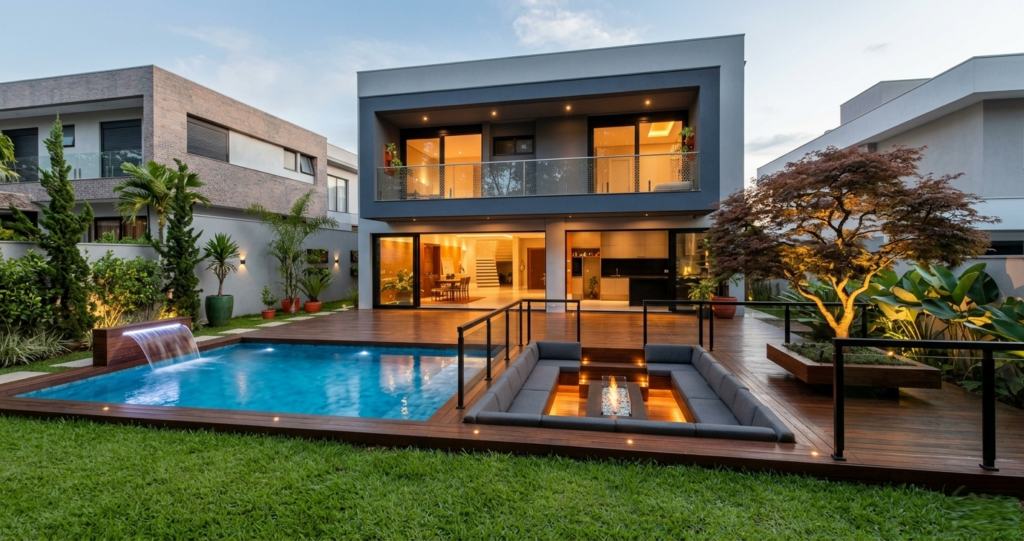
The pool and garden are drawn as one project. The pump, chiller and cover all need a home on the plan.
Who stands behind the pool in each country?
A standard is only as good as the person who can be held to it. Each of our four countries answers that differently.
In several Australian states a pool builder must hold a state licence, and jobs above a set value need insurance that pays out if the builder dies, disappears or goes broke before the work is finished. Owners there check a licence number on a government website before they sign.
In Britain the main route is a trade body. Its members agree to work to its published standards and to follow a code of ethics, and a committee revises those standards as the law changes.
In America the trade association runs a certification for builders, with exams and ongoing training. Many states license pool contractors as well.
Dubai has its own tools, and they are stronger than many owners realise.
- The trade licence. Every company’s licence lists its activities. Read that line and check it fits the work you are buying.
- The permit. Drawings are approved by Dubai Municipality, by Trakhees in areas such as Palm Jumeirah, or by the relevant free zone authority. Your community developer usually has to give a no-objection letter first.
- Structural liability. UAE law makes a contractor and the supervising engineer answerable for serious structural failure for ten years after handover.
- The defects period. A normal contract holds back a small part of the price for twelve months or so and releases it once faults are fixed.
What Dubai lacks is the one-click public check that Australians have. So the owner has to do it by hand. Ask for the licence, the names of three clients from more than five years ago, and proof of insurance. Then phone the three clients.
We have written whole articles on this step. Start with critical questions to ask before hiring, then what to evaluate when comparing builders and avoiding common pitfalls.
How to use the benchmark when you collect quotes
Here is the whole method in seven steps. It takes about two weeks alongside the normal quoting process, and it costs nothing.
Step 1. Send every contractor the same one-page brief.
Give the pool size, the depth, the finish you want and the address. Add one line saying you want the quote broken into named items. If each firm quotes a different pool, you cannot compare them.
Step 2. Ask for six numbers in writing.
Concrete strength. Days of wet curing. Length of the water test. Number of suction outlets and the cover rating. Flow in cubic metres per hour. Pump model. A serious firm answers in a day.
Step 3. Check the paperwork.
Trade licence, insurance, and who will submit the drawings for approval? Ask which authority covers your plot. A builder who does not know has not built in your community.
Step 4. Visit one live site and one old pool.
The live site shows you how they cure, how tidy they keep the steel and what they do with rebound. The old pool, five years or more, shows you how their tile and grout have aged.
Step 5. Tie payments to tests
Do not pay the shell stage on a date. Pay it when the water test passes. Do not pay the final stage until the flow has been measured and the handover file is in your hands.
Step 6. Agree who looks after it.
Ask what the first year of service looks like and what it costs after that. A builder who also maintains has a reason to build well.
Step 7. Get the handover file
As-built drawings, pump and filter manuals, cover ratings, warranty cards, test results, and the water chemistry on the day of handover. Keep it with the house deeds.
Related reading on our site: how to plan your pool project, preparing your property for installation and what to expect during construction.
Fourteen questions and what a good answer sounds like.
Print this table and take it to each meeting. The middle column is what you want to hear. The right-hand column is what should make you careful.
| Question | A good answer | A worrying answer |
|---|---|---|
| What concrete strength is specified? | A grade in MPa, with cube or core tests by a named lab | “Standard mix” or “as per engineer” |
| How long do you cure? | At least seven days kept wet, longer in summer, with covers | “It dries in a couple of days.” |
| Do you test the bare shell? | Yes, with a control bucket, and you are invited. | “We test at the end.” |
| How many suction outlets? | Two or more, spaced apart, with rated covers | “One main drain is enough.” |
| What is the turnover time? | Four hours or better, with the flow figure | “The pump is one and a half horsepower.” |
| Is the pump variable speed? | Yes, with the model number | “Single speed is more reliable.” |
| Where does the plant room go? | Shown on the drawing with ventilation and drainage | “We will decide on-site.” |
| What stops the pool lifting when empty? | A relief valve or a drainage design based on the ground | “That does not happen here.” |
| Which authority approves this plot? | Named, with the usual time it takes | “No permit needed for a villa” |
| How is the gate designed? | Opens outward, closes and latches by itself | “The fence company handles that.” |
| Who does the gardening around it? | Same firm, same drawing | “You will need a separate landscaper.” |
| What is in the handover file? | Drawings, manuals, test sheets, warranties | “We give you the keys.” |
| Who services it afterwards? | Their own trained staff, with a written plan | “Any cleaner can do it.” |
| What is held back for defects? | A stated percentage for a stated time | “We do not do retention.” |
Swipe the table sideways to see every column.
No builder scores fourteen out of fourteen in the first meeting. But the way a firm reacts to the list tells you a lot. Good ones enjoy it.
What no foreign rulebook covers
British, American and Australian standards were written for their own ground and weather. Four things about Dubai sit outside all of them, and a builder here has to know them from experience.
The ground pushes back.
On reclaimed and coastal plots the water table can sit a metre or two below the garden. An empty concrete pool is a boat. Drain it without a relief valve, and the groundwater can lift it out of level or crack the floor. Inland plots on sand and rock behave differently again. The first thing a careful builder asks for is a soil report, and the answer changes the floor thickness, the steel and the drainage under the slab.
The tap water is hygienic.
Most of Dubai’s mains water starts in the sea and comes out of a desalination plant very low in calcium. Water like that tries to take calcium from whatever it touches. In a pool, that means the grout and the plaster. Left alone, it roughens a new finish within a couple of seasons. The cure is cheap. Test the fill water, raise the calcium at start-up and keep checking it.
Dust is a filter problem.
A shamal can drop a fine layer of dust on a pool in an afternoon. Most of it is too fine to net. It has to be filtered out, which loads the filter far faster than leaves or insects do. Filters in Dubai need to be sized up and backwashed more often than the maker’s leaflet suggests.
Sun ages everything
Plastic fittings, cover rollers, grout sealers and pool lights all age faster under our sun. A drain cover rated for seven years in a mild climate may not be safe that long here. Build the replacement dates into the service plan.
For more on local conditions, see preparing your pool for summer, materials for Dubai’s climate, choosing pool tiles and rooftop pool engineering.
Why Green Creation is the contractor we would measure others against
We are writing about our own company here, so judge the claims the way this guide tells you to judge anyone. Ask us for the numbers.

See our work in the project gallery, read about us, or go straight to pool design, pool builders, luxury pools and the full list of services. Our case for the top spot is also set out in why Green Creation is the best swimming pool contractor in Dubai.
How we differ from a typical competitor
We have not named other firms here. This is our own website, and it would not be a fair fight. The table compares the way we work with what is common in the Dubai market.
| Area | Common in the market | Green Creation |
|---|---|---|
| Scope | Shell and equipment only, garden by others | Pool, deck, planting, lighting and barrier in one contract |
| Quote | One lump sum with a short description | Each component was agreed upon and priced separately. |
| Commercial work | Villas only | Villas, hotels and developer projects up to Olympic size |
| Repairs underwater | Drain the pool first. | Commercial divers work with the pool full. |
| Start of service | A cleaner arrives. | Pool audit and fill-water test before the plan is priced |
| Yearly review | None | Pump curve, filter, controller and upgrade advice |
| Track record | A few hundred jobs | 8,940 completed projects and more than 5,500 clients |
Swipe the table sideways to see every column.
If you would like to compare firms by name, our article on the top swimming pool construction companies in Dubai does that, and so does this comparison of services.
What building costs more than the higher standard?
Owners often assume that a pool built to stricter rules costs far more. Mostly it does not. Wet curing costs water and a labourer’s time. A water test costs a tanker fill and two weeks of patience. A second drain costs a fitting and a few metres of pipe.
The real extra money is in three items. A variable speed pump costs more than a single-speed one and pays that back in power bills. A chiller is a large item. And a proper soil report is a few thousand dirhams; most cheap quotes leave out.
Search for swimming pool construction in Dubai, and you will find prices all over the place. The ranges below are market figures for concrete pools before VAT. They are a guide for budgeting and not a quotation.
| Pool type | Typical size | Market range (AED) |
|---|---|---|
| Plunge pool | Up to 4 m by 2.5 m | 55,000 to 120,000 |
| Family villa pool | 6 m by 3 m | 90,000 to 170,000 |
| Larger villa pool | 8 m by 4 m | 120,000 to 230,000 |
| Lap pool | 15 m to 25 m long | 180,000 to 500,000 |
| Infinity edge pool | Varies | 280,000 to 500,000 and above |
Swipe the table sideways to see every column.
What moves a price inside its range is mostly access, ground and finish. A plot a digger cannot reach has to be dug by hand. A high water table means pumping during the dig. Glass mosaic costs several times what ceramic does. More detail is in the cost of building a pool in Dubai, the budget against high-end pools and our guide to costs, materials and timelines.

Finish and access move the price more than the standard of the concrete does.
After handover, when the builder’s work is tested
A pool is tested every day for the next thirty years, long after the builder has left. The standards in this guide decide how those years go. A dense shell stays dry inside. A measured flow keeps the water clear. A rated drain cover replaced on time keeps swimmers safe.
The owner’s part is steady, boring care. In Dubai that means a visit every week, because the heat does not allow a fortnight’s neglect in summer. Each visit should end with a written record of the chlorine, the pH and what was done.
- For the routine, read how often to schedule maintenance and the seasonal checklist.
- For water quality, see pool water testing and analysis, pH and alkalinity stabilisation and algae prevention.
- For equipment, see pump and motor diagnostics, filter media maintenance and preventive maintenance planning.
- For the structure, see structural and surface integrity and swimming pool repair.
- For contracts, see why an annual maintenance contract is worth it and what maintenance costs.
Our service pages cover villa pool maintenance, commercial pool maintenance, weekly cleaning and compliance. If your pool is older and was not built this way, renovation can bring the drains, pump and finish up to date without rebuilding the shell.
Further reading on green-creation.com
- Swimming pool construction in Dubai, our main guide to engineering and long-term performance
- Swimming pool construction from concept to completion
- A step-by-step guide for villa owners
- Pool contractors in Dubai, a practical guide for homeowners and developers
- Top quality and safety in pool construction
- Pool permits and regulations every owner must know
- Infinity pools and how they are engineered
- Indoor swimming pools in Dubai
- Lap pools and plunge pools for compact plots
- Commercial pools for hotels, resorts and developers
- Pool water features
- Eco-friendly pool building practices
- In-ground and above-ground pools compared
- Choosing the right pool shape
- What a pool adds to property value
- The best residential communities for private pools
- Why local pool experts matter
- Professional building against doing it yourself
- Common pool problems in Dubai and how to avoid them
- Year-round pool maintenance in Dubai
Frequently asked questions
Who are the best swimming pool contractors in Dubai?
The best ones can give you numbers in writing. Ask for the concrete strength, the days of wet curing, the length of the water test, the number of suction outlets, the flow rate and the pump model. Green Creation, with 8,940 completed projects and clients including Emaar, Sobha and Hilton, prices every component separately so each of those can be checked.
What makes one swimming pool construction company in Dubai better than another?
Three things you can verify. Their paperwork, meaning the licence, insurance and approved drawings. Their tests, meaning cube results, a witnessed water test and a measured flow. And their old pools, which show how the tile and grout have held up after five summers.
Does a Dubai pool have to meet British, American or Australian standards?
No. The law here is Dubai Municipality’s technical guideline, or the Trakhees, or the free zone equivalent for your plot. Foreign standards are useful as a yardstick where the local rule is silent, such as curing time, drain cover ratings and gate latches.
What concrete strength should a pool shell have?
American shotcrete practice sets a minimum of 4,000 psi in place, which is 27.6 MPa. Your structural engineer may ask for more depending on the ground. Whatever the figure, it should be written in the specification and proved by lab tests on cubes or cores from your own pool.
How long should a new pool shell be cured in Dubai?
At least seven days kept continuously wet, and longer is better. In summer the shell should also be covered with wet hessian or plastic sheet because a bare wall in 45 degrees heat dries in minutes. A plaster finish benefits from twenty-eight days of moist curing first.
How is a pool tested for leaks before tiling?
The bare shell is filled and left to soak, then the level is marked and watched for several days. A bucket of the same water stands beside it to measure evaporation. If the pool drops more than the bucket, there is a leak, and it gets fixed before waterproofing and tile go on.
How many drains does a pool need?
Dubai Municipality asks for two main drains. They should be spaced apart and piped so that covering one leaves the other open. Each cover carries a stamped flow rating, which must be higher than the flow your pump can pull through it.
Is a pool fence required in Dubai?
Dubai Municipality’s guideline calls for a barrier of about 1.2 m around the pool, and many community developers add their own rules. For the details, borrow from Australia. Gates should open away from the water and close and latch by themselves, and nothing climbable should stand within 900 mm of the outside.
What turnover rate should a villa pool have?
Four hours or better under the local guideline. For a 45 cubic metre pool that means just over 11 cubic metres an hour measured at the pool. Ask for that flow to be measured at handover and written in your file.
Is a variable speed pump worth the extra cost?
In Dubai, yes. The pump runs every day of the year. At half speed it draws roughly one-eighth of the power, so longer hours at low speed filter the same water for about a quarter of the electricity. Most owners recover the price difference well inside the pump’s life.
Do I need a pool chiller in Dubai?
If you want to swim in July and August, almost certainly. Unshaded pool water can pass 34 degrees. A chiller or a reversible heat pump brings it back to a comfortable 28 to 30 degrees and slows algae growth. It needs space, power and pipework, so decide before the plant room is drawn.
How long does it take to build a swimming pool in Dubai?
A straightforward concrete villa pool usually takes three to four months on site once the permit is issued. Approvals can add several weeks before that. A builder who promises six weeks is leaving out the curing and the water test.
How much does swimming pool construction in Dubai cost?
Market ranges before VAT run from about AED 90,000 to 170,000 for a 6 m by 3 m family pool and AED 120,000 to 230,000 for an 8 m by 4 m pool. Infinity edges, chillers, glass mosaic and difficult access all push the figure up.
Which authority approves a pool in Dubai?
It depends on the plot. Dubai Municipality covers most of mainland Dubai. Trakhees covers areas such as Palm Jumeirah and other Nakheel communities. Some free zones have their own authority. Your community developer normally has to issue a no-objection letter before any of them will look at the drawings.
What warranty should a pool contractor give?
Expect a defects period of around twelve months with part of the price held back until faults are fixed. Equipment carries the maker’s own warranty. UAE law also holds the contractor and supervising engineer answerable for serious structural failure for ten years.
Can a pool be repaired without draining it?
Often, yes. Green Creation’s maintenance team includes commercial divers who are qualified pool engineers. They replace lights, tiles and drain covers and seal small cracks with the pool full, which saves the water and avoids the risk of an empty shell lifting on high ground water.
Why does Dubai tap water damage pool finishes?
Most of it is desalinated and very low in calcium. Water that is soft pulls calcium out of grout and plaster. Testing the fill water and raising the calcium hardness when the pool is first filled prevents it.
Should the same company build the pool and the garden?
It helps a great deal. The deck falls, the fence line, the planting near the barrier and the route for pipes all cross between pool and garden. Green Creation began as a landscaping firm, so both are designed on one drawing and built under one contract.
Does Green Creation work as a subcontractor on large projects?
Yes. We take private villas as turnkey jobs and also work as the specialist pool subcontractor to main contractors on hotels, resorts and residential developments, including pools up to Olympic size.
How do I get a quote from Green Creation?
Call +971 50 948 4081 between 9am and 6pm, or use the contact form on green-creation.com. Have your plot size, the community name and a rough idea of the pool size ready. We visit the site before pricing.
Ask us for the six numbers
Call Green Creation on +971 50 948 4081, 9am to 6pm, and we will put the strength, curing, water test, drains, flow and pump model in writing with your quote.
Prices shown are market ranges and not a quotation. Figures quoted from British, American and Australian practice are given for comparison. The rules that apply to your plot are those of Dubai Municipality, Trakhees or your free zone authority, and your structural engineer’s design takes priority over any general figure in this guide.